Mozart Requiem Sheet Music — Requiem in D minor, KV 626, Maunder Completion
The complete performance edition of Mozart’s Requiem in Richard Maunder’s completion — full score, choral score and all eighteen individual parts for soloists, SATB choir and orchestra in one PDF. Edited by Paul Lorenz.
Regular price €119.00
Now
€89.90
Instant PDF download
See the score & buy
Edition facts
Requiem in D minor, KV 626 (completion by Richard Maunder) by Wolfgang Amadeus Mozart, arranged by Paul Lorenz for SATB choir and orchestra with soprano, alto, tenor and bass soloists: full score (157 pages) and separate parts (443 pages), delivered as a PDF (A4) for instant download, €89.90.
- Instrumentation
- Basset horn (2), Bassoon (2) · Trumpet (2), Trombone (3) · Timpani · Violin I, Violin II, Viola, Cello
- Choir
- SATB
- Soloists
- Soprano, alto, tenor, bass soloists
- Pages
- 600 pages — full score (157) + separate parts (443)
- Key
- D minor
- Duration
- approx. 50 min
- Difficulty
- Advanced (4/5)
- Tempo
- Adagio – Allegro
- Edition
- 2026
- Format
- PDF, A4, instant download
Read from the PDF you download.
Wolfgang Amadeus Mozart left his Requiem in D minor, KV 626 unfinished when he died in December 1791. This edition presents it in the completion by Richard Maunder: Mozart’s fragment, the Lacrymosa from bar 9 and an Amen fugue by Maunder, with Süßmayr’s Sanctus and Benedictus as an appendix. It is the complete performance edition by Paul Lorenz — conductor’s score, choral score and every individual part, delivered as one instant PDF download you own outright. Launch price €89.90 (regular price €119.00).
The edition is laid out for rehearsal and concert. Every singer gets an individual part as well as the choral score, and the solo passages stand on the choir staves, marked “Solo” and “Tutti”. Two basset horns in F, two bassoons, two trumpets in D, three trombones, timpani, the strings and the bass line for violoncello, double bass and organ each have their own part — 600 pages in one file, bookmarked by part and movement. All sixteen movements are included, with the complete Latin text underlaid in the score, the choral score and every voice part.
Choose your “Requiem in D minor, KV 626 (completion by Richard Maunder)” edition
Complete Edition — Full Score, Choral Score & All Parts
SATB choir and orchestra with soprano, alto, tenor and bass soloists · 600 pages: score + parts · PDF (A4)
One PDF, 600 pages: conductor’s score, SATB choral score and eighteen individual parts — basset horns, bassoons, trumpets, trombones, timpani, Soprano, Alto, Tenor, Bass, Violin I, Violin II, Viola and Violoncello.
- Instant PDF download
- Secure checkout
- Licensed edition
Quality in detail
- Everything in One PDF: Full score, SATB choral score and eighteen individual parts for all sixteen movements — 600 pages in a single download, with PDF bookmarks for every part and every movement. Print the pages you need; there is no hire material to order or return, and the file is yours to keep for every performance.
- Richard Maunder’s Completion: Maunder continues Mozart’s Lacrymosa from bar 9 in his own way and closes the Sequence with an Amen fugue. Süßmayr’s Sanctus and Benedictus follow as an appendix — perform them or leave them out.
- Soloists on the Choir Staves: As in Maunder’s score, the four soloists sing from the choir staves, marked “Solo” and “Tutti” — in the Tuba mirum, the Recordare and the Benedictus, and in the solo passages of the Requiem aeternam, the Domine Jesu and the Lux aeterna. Soloists read from the choral score or from their voice part.
- Mozart’s Orchestra, Part by Part: Two basset horns in F, two bassoons, two trumpets in D, alto, tenor and bass trombone in their traditional clefs, timpani and strings — every player has a part with all the movements they play in. The Trombone 2 part carries the famous solo of the Tuba mirum.
- One Bass Line for Cello, Bass and Organ: Mozart writes a single bass line for violoncello, double bass and organ. This edition gives it as the Violoncello part, 28 pages, without figured bass; there is no separate organ part.
- Freshly Engraved: New engraving in A4 with consistent layout, movement titles, tempo marks and bar numbers at the start of every system in score and parts — print-ready and comfortable on a tablet.
Mozart’s Requiem sheet music at a glance
| Work | Requiem in D minor, KV 626 — Wolfgang Amadeus Mozart, 1791, left unfinished at his death |
| Completion | Richard Maunder: Lacrymosa from bar 9 and Amen fugue by Maunder; Sanctus and Benedictus by Süßmayr as an appendix |
| Movements | 16 — Requiem aeternam · Kyrie · Dies irae · Tuba mirum · Rex tremendae · Recordare · Confutatis · Lacrymosa · Amen · Domine Jesu · Hostias · Agnus Dei · Lux aeterna · Cum sanctis · appendix: Sanctus · Benedictus |
| Duration | approx. 45–50 minutes |
| Voicing | SATB choir with soprano, alto, tenor and bass soloists (on the choir staves, marked Solo / Tutti) |
| Instrumentation | 2 basset horns in F, 2 bassoons, 2 trumpets in D, 3 trombones (alto, tenor, bass), timpani, Violin I, Violin II, Viola, violoncello / double bass / organ (one bass line) |
| What you receive | One PDF, 600 pages: full score (157 pages), choral score (65 pages), eighteen individual parts — bookmarks for every part and movement |
| Text | Latin |
| Edition | Paul Lorenz — arrangements recorded with the London Symphony Orchestra at Abbey Road Studios |
| Format | High-resolution PDF, A4 — instant download, print-ready and tablet-friendly |
| Licence | Edition © 2026 Edition Zeitlos, Austria. Print for your ensemble, perform in concert and liturgy — no rental, no return deadline |
| Price | €89.90 launch price (regular €119.00) |
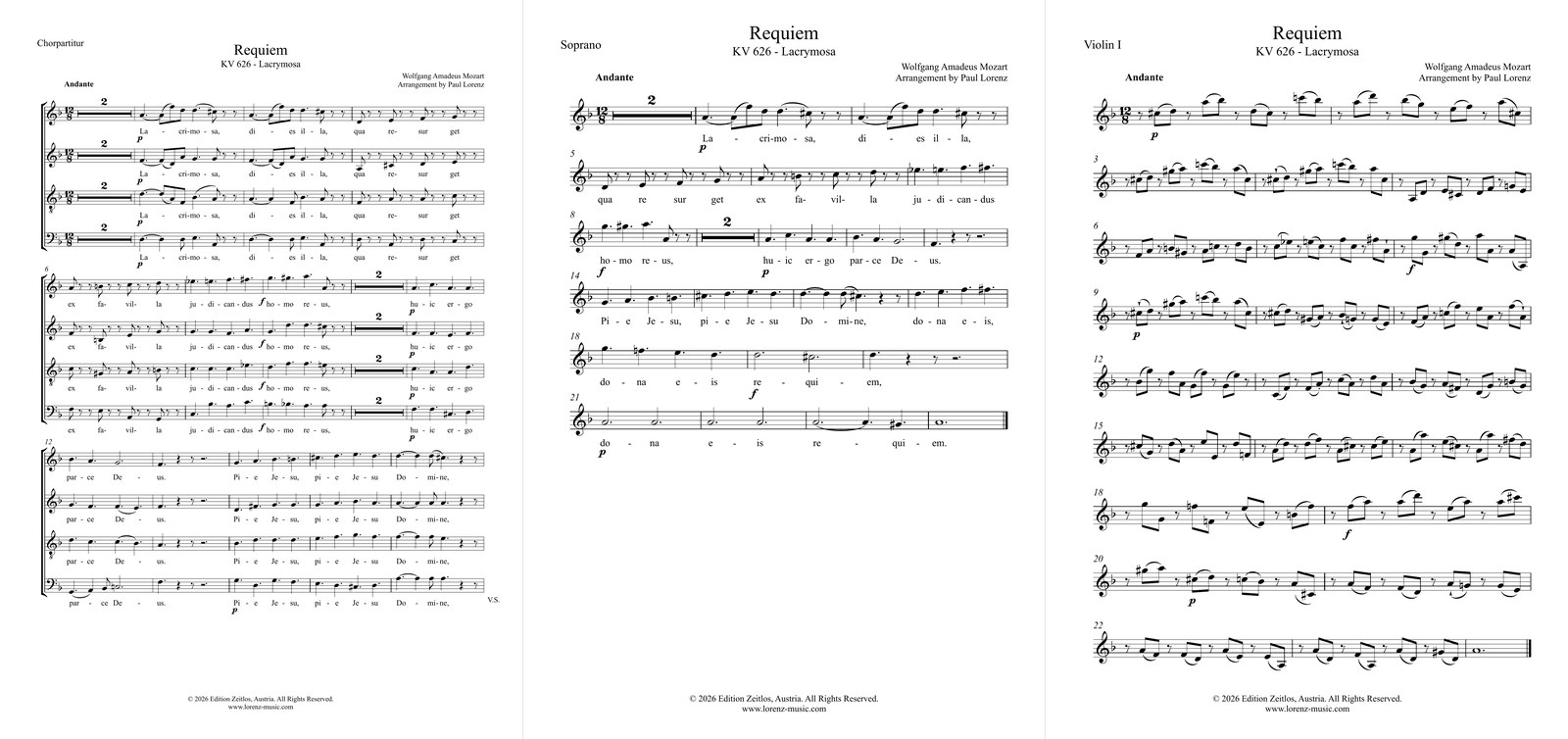
From the Complete Edition: the SATB choral score, the Soprano part and the Violin I part — opening of the Lacrymosa.
What is in the 600 pages
| Section | Pages | For whom |
|---|---|---|
| Full score | 157 | Conductor — all voices and instruments, every movement |
| Choral score (SATB) | 65 | Choir director, soloists, rehearsal |
| Basset Horn in F 1 · 2 | 23 · 24 | Woodwinds |
| Bassoon 1 · 2 | 23 · 20 | Woodwinds |
| Trumpet in D 1 · 2 | 10 each | Brass — ten movements |
| Trombone 1 · 2 · 3 | 18 · 17 · 16 | Brass — alto, tenor and bass trombone; the Tuba mirum solo is in Trombone 2 |
| Timpani | 9 | Nine movements |
| Soprano · Alto · Tenor · Bass | 23 · 24 · 23 · 22 | Individual voice parts, with the solo passages |
| Violin I · Violin II · Viola | 30 · 31 · 27 | Strings |
| Violoncello | 28 | The bass line for violoncello, double bass and organ (without figured bass) |
Every part contains all the movements in which it plays, in order. The bookmarks panel of any PDF reader jumps straight to, say, Trombone 2 → Tuba mirum. The parts carry their English names in the file (Basset Horn in F, Bassoon, Trumpet in D, Violin I); the choral score appears under its German name, “Chorpartitur”.
The sixteen movements
| Movement | Tempo and metre in this edition | Bars | Character |
|---|---|---|---|
| Requiem aeternam | Adagio · 4/4 | 48 | Basset horns and bassoons over pulsing strings; a soprano solo at “Te decet hymnus” |
| Kyrie | Allegro · 4/4 | 52 | Double fugue for the full choir |
| Dies irae | Allegro assai · 4/4 | 68 | The day of wrath, with trumpets and timpani |
| Tuba mirum | Andante · 2/2 and 4/4 | 62 | The four soloists in turn, opened by the trombone solo |
| Rex tremendae | Adagio · 4/4 | 22 | Massive dotted rhythms, ending in a plea |
| Recordare | Andante · 3/4 | 130 | The longest movement — a quartet for the four soloists |
| Confutatis | Andante · 4/4 | 40 | Men’s voices against hushed women’s voices |
| Lacrymosa | Andante · 12/8 | 24 | Mozart’s first eight bars, continued by Maunder |
| Amen | Allegro · 3/4 | 79 | Maunder’s fugue, closing the Sequence |
| Domine Jesu | Allegro · 4/4 | 78 | Offertory, with a solo quartet and the fugue “Quam olim Abrahae” |
| Hostias | Andante · 3/4 — Allegro · 4/4 | 89 | Calm in E-flat, then the fugue returns |
| Agnus Dei | Larghetto · 3/4 | 47 | Forceful cries of “Agnus Dei” against quiet pleas for rest |
| Lux aeterna | Adagio · 4/4 | 30 | Returns to the music of the opening, with soprano solo |
| Cum sanctis | Allegro · 4/4 — Adagio | 52 | The Kyrie fugue on the words of the Communion |
| Sanctus (appendix) | Adagio · 4/4 — Allegro · 3/4 | 38 | Süßmayr: brief and festive, with an Osanna fugue |
| Benedictus (appendix) | Andante · 4/4 — Allegro · 3/4 | 76 | Süßmayr: the solo quartet, then the Osanna once more |
Why Maunder’s completion
Every performance of the Requiem uses someone’s completion, because Mozart did not live to finish it. The version most choirs grew up with is Franz Xaver Süßmayr’s. Richard Maunder’s keeps Mozart’s own music and the movements that rest on it, writes a new continuation of the Lacrymosa from Mozart’s eight bars, and ends the Sequence with an Amen fugue where Süßmayr has only a closing cadence. Süßmayr’s Sanctus and Benedictus stand in the appendix: a conductor can perform the Requiem as Maunder presents it, or include the two movements for a liturgy or a concert that expects them.
Programming the Requiem
At about forty-five to fifty minutes the Requiem fills the larger part of a concert and is often paired with a short first half. Mozart’s own Ave Verum Corpus, written in the same year, and the Laudate Dominum KV 339 for soprano and choir make natural companions; for a remembrance concert, Barber’s Agnus Dei sets a very different stillness beside it. Choirs looking for Mozart in a brighter key will find it in the Coronation Mass KV 317.
More repertoire for choir and church is in the sacred choral catalogue and the choir editions. If you need clarinets instead of basset horns, a written-out organ part or a reduced orchestra for the players you have, ask before you buy — bespoke adaptation is part of what this publisher does.
Own this arrangement? Share your review →
Requiem in D minor, KV 626 (completion by Richard Maunder) sheet music — frequently asked questions
What exactly is included in the Complete Edition?
One PDF of 600 pages with all sixteen movements: the full conductor’s score (157 pages), the SATB choral score (65 pages), and individual parts for Basset Horn in F 1 (23 pages) and 2 (24), Bassoon 1 (23) and 2 (20), Trumpet in D 1 and 2 (10 each), Trombone 1 (18), 2 (17) and 3 (16), Timpani (9), Soprano (23), Alto (24), Tenor (23), Bass (22), Violin I (30), Violin II (31), Viola (27) and Violoncello (28). PDF bookmarks take you straight to every part and movement. The file is A4, print-ready and works on a tablet.
Which version of the Requiem is this?
The completion by Richard Maunder. The Requiem aeternam, the Kyrie, the Sequence up to the Confutatis and the Offertory rest on what Mozart wrote himself, as in every completion. From bar 9 of the Lacrymosa the music is Maunder’s, and he closes the Sequence with an Amen fugue. Süßmayr’s Sanctus and Benedictus are printed as an appendix at the end. Choirs who know the familiar Süßmayr version will notice the difference above all in the Lacrymosa and the Amen.
What is the instrumentation?
Four soloists (soprano, alto, tenor, bass), SATB choir, 2 basset horns in F, 2 bassoons, 2 trumpets in D, 3 trombones (alto, tenor, bass), timpani, Violin I, Violin II, Viola, and one bass line for violoncello, double bass and organ. The trumpets play in ten movements and the timpani in nine; the trombones rest in the Recordare, and in the Tuba mirum only the second trombone plays — its solo.
Do we need soloists?
Yes, four — soprano, alto, tenor and bass. They sing the Tuba mirum, the Recordare and the Benedictus, the quartet passage in the Domine Jesu, and the soprano has short solos in the Requiem aeternam and the Lux aeterna. Every solo passage is printed on the choir staves, marked “Solo” and “Tutti”, so soloists read from the choral score or from their voice part.
Is there a piano reduction or a separate organ part?
No. The 65-page choral score contains the four choir staves with the solo passages, without a piano reduction. The organ plays Mozart’s bass line together with violoncello and double bass; this edition prints that line as the Violoncello part, without figured bass, so the organist plays from that part or from the score. If you need a figured or written-out organ part, please ask before you buy.
Can clarinets play the basset-horn parts?
The parts are written for basset horns in F, as Mozart scored them. If your orchestra has no basset horns and you need parts for clarinets in B-flat or A, Paul Lorenz will adapt the edition on request — please get in touch before you buy.
How long does the Requiem take to perform?
About 45 to 50 minutes for all sixteen movements, depending on tempo and on whether you include the Sanctus and Benedictus of the appendix. The edition gives tempo words but no metronome marks.
How difficult is it?
The Requiem is demanding but within reach of a well-prepared amateur choir. The work in rehearsal goes into the fugues — the Kyrie, the Domine Jesu, the Amen and the closing Cum sanctis — into the fast declamation of the Dies irae and the Confutatis, and into a wide dynamic range. The soloists need secure voices, and the second trombone plays the exposed solo of the Tuba mirum. The orchestral parts suit capable amateur and professional players.
Why buy this edition instead of a free scan?
Free scans of old editions give Süßmayr’s completion, and seldom the parts you need. This edition gives you Maunder’s version as a performance library in one file: a full score, a choral score, an individual part for every voice section and for every instrument — freshly engraved and matching bar for bar. The realistic alternative is not a free download; it is hire material or evenings of extracting parts before the first rehearsal.
Is the text in Latin?
Yes. The complete Latin text of the Requiem Mass is underlaid in the full score, the choral score and each of the four voice parts.
What licence do we get, and what is the refund policy?
This edition is published by Edition Zeitlos, Austria. Your purchase licenses you to print the parts for your own ensemble and to perform the Requiem with the purchasing ensemble in concert and liturgy — you own the file, there is no rental and no return deadline. Any reporting of the public performance to a performing-rights society (GEMA/AKM/SUISA, or ASCAP/BMI/PRS elsewhere) is handled by the organiser as usual. Because the complete file is delivered immediately, downloads cannot be refunded; please study the score previews on this page, and contact us for extended sample pages before buying if you would like to see more.
How long is the launch price valid?
The Complete Edition is offered at €89.90 for its launch instead of the regular €119.00. Buy now and the file is yours at that price — including every future correction of this edition, which you can download again from your order page.
Can the edition be adapted?
Yes — bespoke adaptation is a core service of Paul Lorenz. Clarinet parts instead of basset horns, a separate double-bass part, an organ part, transpositions or a reduced orchestra for the forces you actually have are available on request. Please get in touch before you buy.