Mozart Coronation Mass Sheet Music — Missa in C, KV 317
The complete performance edition of Mozart’s Coronation Mass — full score, choral score and all 16 individual parts in one PDF. Prepared by Paul Lorenz and performed by him many times with orchestra, choir and organ.
Edition facts
Coronation Mass (Missa in C, KV 317) by Wolfgang Amadeus Mozart, arranged by Paul Lorenz for SATB choir and orchestra with soprano, alto, tenor and bass soloists: full score (121 pages) and separate parts (243 pages), delivered as a PDF (A4) for instant download, €89.90.
- Instrumentation
- Oboe (2) · Horn (2), Trumpet (2), Trombone (3) · Timpani · Organ · Violin I, Violin II, Cello, Double bass
- Choir
- SATB
- Soloists
- Soprano, alto, tenor, bass soloists
- Pages
- 365 pages — full score (121) + separate parts (243)
- Key
- C major
- Duration
- approx. 22 min
- Difficulty
- Intermediate (3/5)
- Tempo
- Andante maestoso – Allegro con spirito
- Edition
- 2026
- Format
- PDF, A4, instant download
Read from the PDF you download.
Mozart’s Missa in C major, KV 317 — the “Coronation Mass” — is twenty to twenty-five minutes of the most festive church music Mozart wrote in Salzburg: soli and SATB choir with oboes, horns, trumpets, three trombones, timpani, strings and organ, finished in March 1779 and sung in cathedrals and parish churches ever since. This is the complete performance edition by Paul Lorenz — conductor’s score, choral score and every individual part, delivered as one instant PDF download you own outright. Launch price €89.90 (regular price €119.00).
What makes this edition different is where it comes from. Paul Lorenz has performed the Coronation Mass on numerous occasions with orchestra, choir and organ, and this material is laid out for exactly that situation: a realised organ part with figured bass, separate cello and double-bass parts, trumpets in B-flat and horns in F, three individual trombone parts, a choral score for the whole choir and an individual part for every voice section — 365 pages, one file, bookmarked by part and movement.
Read the story behind this arrangement →
Hear the arrangement
A 30-second excerpt from the Agnus Dei, from Paul Lorenz’ own studio recording. The edition you download is the full score, choral score and all parts shown in the preview.
Choose your “Coronation Mass (Missa in C, KV 317)” edition
Complete Edition — Full Score, Choral Score & All Parts
SATB choir and orchestra with soprano, alto, tenor and bass soloists · 365 pages: score + parts · PDF (A4)
Every part also for other instruments – included ↓
One PDF, 365 pages: conductor’s score, SATB choral score and 16 individual parts — oboes, horns in F, trumpets in B-flat, alto, tenor and bass trombone, timpani, Violin I & II, cello, double bass, a realised organ part and individual soprano, alto, tenor and bass parts.
- Instant PDF download
- Secure checkout
- Licensed edition
Parts for your instrumentation
Every instrumental part of this edition is also available for other instruments – included in the price. Transposed, in the right clef, checked for range and breathing.
| Original part | Also available for |
|---|---|
| Oboe | Violin, Viola |
| Horn in F | Violin, Viola |
| Trumpet in B♭ | Violin, Viola |
| Trombone I | Alto saxophone in E♭, English horn in F, Viola, Tenor saxophone in B♭, Bassoon, Bass clarinet in B♭, Cello, Double bass |
| Trombone II | Horn in F, English horn in F, Viola, Tenor saxophone in B♭, Euphonium, Bassoon, Bass clarinet in B♭, Cello, Double bass |
| Trombone III | Alto saxophone in E♭, English horn in F, Viola, Tenor saxophone in B♭, Euphonium, Bassoon, Bass clarinet in B♭, Cello, Double bass |
| Soprano | Flute, Oboe, Clarinet in B♭, Soprano saxophone in B♭, Violin, English horn in F, Viola |
| Alto | Flute, Oboe, Clarinet in B♭, Soprano saxophone in B♭, Violin, Alto saxophone in E♭, English horn in F, Flugelhorn in B♭, Viola, Tenor saxophone in B♭, Cello |
| Tenor | Flute, Oboe, Clarinet in B♭, Soprano saxophone in B♭, Violin, Alto saxophone in E♭, Horn in F, English horn in F, Viola, Tenor saxophone in B♭, Bassoon, Bass clarinet in B♭, Cello |
| Bass | Alto saxophone in E♭, English horn in F, Viola, Tenor saxophone in B♭, Trombone, Euphonium, Bassoon, Bass clarinet in B♭, Cello, Double bass |
| Violin II | Viola |
| Cello | Alto saxophone in E♭, English horn in F, Viola, Trombone, Euphonium, Bassoon, Bass clarinet in B♭, Double bass |
Buy. After your purchase you receive your personal link to the Part Configurator by e-mail.
Choose part and instrument. For example the Soprano part as Flute.
Download the PDF. The first time a part is requested it takes about a minute to set; after that it is ready at once – with your name as the license notice.
How the Part Configurator works → Need a different instrumentation? After your purchase you can send Paul Lorenz a request.
Quality in detail
- Everything in One PDF: Full score, SATB choral score and 16 individual parts for all six movements — 365 pages in a single download, with a contents page and PDF bookmarks for every part and every movement. Print the pages you need, nothing to order separately, yours to keep and reprint every season.
- Realised Organ Part: Not a bare continuo line. The organ part is written out on two staves, with the figured bass printed under the notes and “tasto solo” where the soloists sing — an organist can play it as printed and still read Mozart’s harmony.
- A Part for Every Singer: Besides the choral score, sopranos, altos, tenors and basses each get their own part with only their line and text — lighter to carry, quicker to mark, and the solo passages marked SOLO and TUTTI exactly where they fall.
- Three Trombones, Separately Engraved: Mozart’s alto, tenor and bass trombones double the choir, as in Salzburg Cathedral. Here each trombonist gets an individual part — the alto trombone in alto clef — instead of reading over a singer’s shoulder.
- Modern Brass Notation: Trumpets are notated in B-flat and horns in F, so the brass section of a modern orchestra plays at sight with no transposing from C.
- Proven in Performance: Not a desk edition. Paul Lorenz has conducted this mass many times with orchestra, choir and organ — the layout, page turns and markings come from real rehearsals and real services.
Mozart’s Coronation Mass sheet music at a glance
| Work | Missa in C major, KV 317, “Krönungsmesse” / “Coronation Mass” — Mozart, Salzburg, autograph dated 23 March 1779; public domain |
| Movements | Kyrie · Gloria · Credo · Sanctus · Benedictus · Agnus Dei |
| Duration | approx. 20–25 minutes, depending on tempo |
| Voicing | Soprano, alto, tenor and bass soli with SATB choir (solos in the choir staves, marked SOLO / TUTTI) |
| Instrumentation | 2 Oboes, 2 Horns in F, 2 Trumpets in B-flat, Alto, Tenor and Bass Trombone, Timpani, Violin I, Violin II, Violoncello, Double Bass, Organ |
| What you receive | One PDF, 365 pages: full score (121 pages), choral score (37 pages), 16 individual parts — contents page and bookmarks for every part and movement |
| Arranger / Editor | Paul Lorenz — performed this mass many times with orchestra, choir and organ; arrangements recorded with the London Symphony Orchestra at Abbey Road Studios |
| Difficulty | Grade 3 — experienced church, community and semi-professional choirs; advanced amateur to professional orchestra |
| Format | High-resolution PDF, A4 — instant download, print-ready and tablet-friendly |
| Licence | Public-domain work; edition © Edition Zeitlos, Austria. Print for your ensemble, perform in concert and liturgy — no rental, no return deadline |
| Price | €89.90 launch price (regular €119.00) |
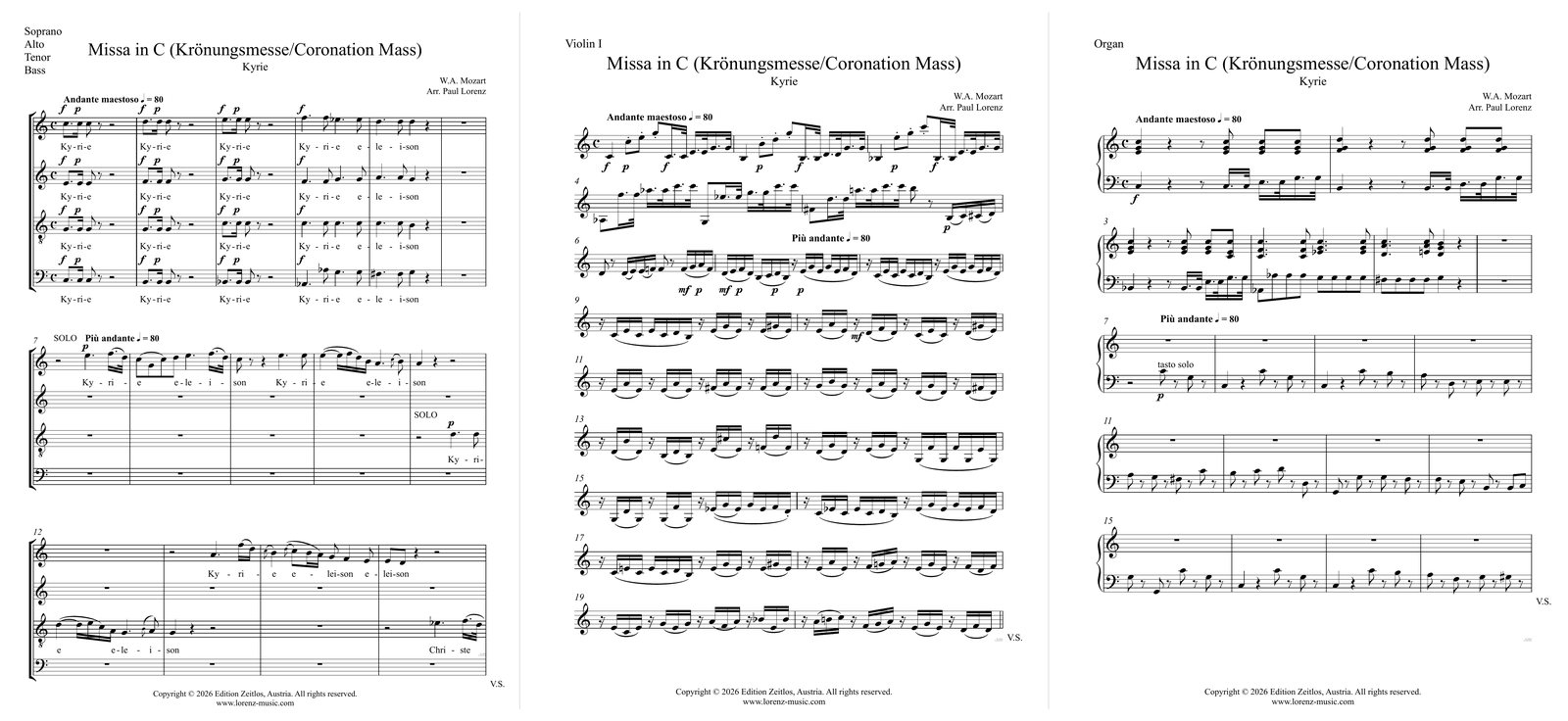
From the Complete Edition: the SATB choral score, the Violin I part and the organ part with figured bass — opening of the Kyrie.
What is in the 365 pages
| Section | Pages | For whom |
|---|---|---|
| Full score | 121 | Conductor — every instrument and voice, every movement |
| Choral score (SATB) | 37 | Choir director, rehearsal pianist, soloists |
| Oboe I & II | 12 | Woodwinds |
| Horn I & II in F | 10 | Brass |
| Trumpet I & II in B-flat | 8 | Brass |
| Alto · Tenor · Bass Trombone | 9 each | Brass — doubling alto, tenor and bass of the choir |
| Timpani | 8 | Percussion |
| Violin I · Violin II | 19 · 17 | Strings |
| Violoncello · Double Bass | 14 · 15 | Strings — separate parts, not one shared bass line |
| Organ | 23 | Organist — two staves, realised right hand, figured bass |
| Soprano · Alto · Tenor · Bass | 14 · 13 · 13 · 13 | Individual voice parts for the choir sections |
Every section contains all six movements in order. The PDF opens with a contents page, and the bookmarks panel of any PDF reader jumps straight to, say, Violin II → Credo.
What a free scan doesn’t give you
| Typical 19th-century score | This edition |
|---|---|
| Organ as a bass line with figures | A realised organ part on two staves, figured bass kept, “tasto solo” in the solo passages |
| One “Basso” line for cello and bass | Separate violoncello and double-bass parts |
| Horns and trumpets in C | Horns in F, trumpets in B-flat — modern notation |
| Trombones only implied by the choir lines | Three individual trombone parts, alto trombone in alto clef |
| Vocal score bought separately | Choral score and individual S, A, T, B parts included |
| Old engraving, dense pages | Freshly engraved, consistent layout, English instrument names for international use |
Why I prepared this edition: I have performed the Coronation Mass many times with orchestra, choir and organ, and every time the same evenings went into copying, correcting and reorganising material before the first rehearsal. This edition is the material I wanted on the stands — complete, consistent and ready the day you buy it.
— Paul Lorenz, arranger and conductor
The six movements
| Movement | Tempo in this edition | Character |
|---|---|---|
| Kyrie | Andante maestoso — Più andante | Hammered forte–piano chords, then the soprano and tenor solos float over the strings |
| Gloria | Allegro con spirito | Brilliant ¾ time, trumpets and timpani, choir and soloists in quick exchange |
| Credo | Allegro molto | The driving centre of the mass, with a hushed, slower Et incarnatus est |
| Sanctus | Andante maestoso — Allegro assai | Short and radiant, with an energetic Osanna |
| Benedictus | Allegretto | The solo quartet in graceful dialogue, framed by the returning Osanna |
| Agnus Dei | Andante sostenuto — Allegro con spirito | The famous soprano solo, then a jubilant Dona nobis pacem |
Why the “Coronation Mass” still fills churches
Mozart was twenty-three when he finished KV 317 for Salzburg Cathedral, and the mass shows everything Salzburg asked of him: festive C major with trumpets and timpani, a liturgy that does not drag, and choral writing that a good church choir can learn in a few rehearsals. The Agnus Dei is the moment audiences remember — a soprano solo whose melody Mozart returned to seven years later for the Countess’s “Dove sono” in The Marriage of Figaro. The name “Coronation Mass” came later, in the nineteenth century, when the work was a favourite at coronation and thanksgiving services of the imperial court in Vienna.
Programming the Coronation Mass
At twenty to twenty-five minutes, KV 317 fits the great feasts of the church year — Easter, Pentecost, Corpus Christi, Christmas, a patronal festival — as well as an orchestral mass for a jubilee or a wedding. In concert it makes a complete first half, or pair it with Mozart’s Ave Verum Corpus as a quiet counterweight. Choirs that know the Sparrow Mass KV 220 will find the Coronation Mass the natural next step — the same Salzburg forces, on a larger scale.
For the forces you need, a five-rehearsal plan and how to cast the Agnus Dei solo, read the conductor’s guide to performing KV 317.
More repertoire for the same forces is in the sacred choral catalogue and the choir editions. If you need a transposition, a reduced scoring or a voicing adapted to the singers you actually have this season, ask before you buy — bespoke adaptation is part of what this publisher does.
Own this arrangement? Share your review →
Coronation Mass (Missa in C, KV 317) sheet music — frequently asked questions
What exactly is included in the Complete Edition?
One PDF of 365 pages with all six movements (Kyrie, Gloria, Credo, Sanctus, Benedictus, Agnus Dei): the full conductor’s score (121 pages), the SATB choral score (37 pages), and individual parts for Oboe I & II, Horn I & II in F, Trumpet I & II in B-flat, Alto Trombone, Tenor Trombone, Bass Trombone, Timpani, Violin I, Violin II, Violoncello, Double Bass and Organ, plus individual Soprano, Alto, Tenor and Bass parts. A contents page and PDF bookmarks take you straight to every part and movement. The file is print-ready and works on a tablet.
What is the instrumentation of Mozart’s Coronation Mass?
Soprano, alto, tenor and bass soloists with SATB choir; 2 oboes, 2 horns, 2 trumpets, 3 trombones (alto, tenor, bass), timpani, Violin I, Violin II, violoncello, double bass and organ. Like most of Mozart’s Salzburg church music, the mass has no viola part. In this edition the solo passages stand in the choir staves (marked SOLO and TUTTI), the horns are notated in F and the trumpets in B-flat.
Is there a choral score with organ?
The edition contains a choral score with the four choir staves (SATB, including the solo passages) and a separate, fully written-out organ part on two staves with figured bass. For rehearsals the organist or répétiteur plays from the organ part while the choir sings from the choral score or from the individual voice parts.
Why is it called the “Coronation Mass”?
The title is not Mozart’s. He wrote the mass in Salzburg and dated the autograph 23 March 1779; it was most likely first heard at Easter that year in Salzburg Cathedral. The nickname became attached in the nineteenth century, when the mass was a favourite at coronation and thanksgiving services of the imperial court in Vienna — and it has stayed, because the music sounds exactly like that.
How long does the Coronation Mass take to perform?
About 20 to 25 minutes for all six movements, depending on tempo — the Credo and the Agnus Dei with its Dona nobis pacem are the longest movements, the Sanctus the shortest. That makes it long enough to carry a festive high mass or the first half of a concert, and short enough to fit a Sunday liturgy without cuts.
Do we need four soloists?
Mozart writes soprano, alto, tenor and bass solos — most prominently the soprano solo of the Agnus Dei, whose melody anticipates the Countess’s aria “Dove sono” in The Marriage of Figaro. Many choirs take the solo quartet from their own ranks; for a feast day or a concert, engaging a soprano soloist for the Agnus Dei pays off most. In this edition the solos are printed in the choir staves, so soloists and choir read from the same pages.
Can we perform it with reduced forces?
Yes. The organ part is written out, so the mass works with choir and organ alone; strings and organ give a full sound for a smaller church; oboes, horns, trumpets, trombones and timpani then complete the festive scoring. If you need a transposition, a reduced scoring or an alternative voicing, Paul Lorenz adapts the edition on request — please ask before you buy.
Mozart is public domain — why buy this edition instead of a free scan?
Mozart’s music is public domain, and scans of nineteenth-century editions do exist. What they do not give you is a performance library: a playable organ part instead of a figured bass line, separate cello and double-bass parts, brass in modern notation, three individual trombone parts, individual voice parts and a matching choral score — freshly engraved, with clear page turns, in one file. The realistic alternative is not a free download; it is several evenings of copying and extracting parts before the first rehearsal.
What difficulty level is this?
Grade 3 (intermediate). The choir writing is largely homophonic and the notes learn quickly; the Gloria and the Credo need a firm Allegro and clean diction. The string parts of the fast movements are the most demanding — comfortable for advanced amateur, semi-professional and professional orchestras. Bespoke customisation is a core service: transpositions, reduced scorings or added instruments on request.
What licence do we get, and what is the refund policy?
Mozart’s composition is in the public domain, so no royalties are due for the work itself. This edition is published by Edition Zeitlos, Austria, and your purchase licenses you to print the parts for your own ensemble and to perform the mass with the purchasing ensemble in concert and liturgy — you own the file, there is no rental and no return deadline. Any reporting of the public performance to a performing-rights society (GEMA/AKM/SUISA, or ASCAP/BMI/PRS elsewhere) is handled by the organiser as usual. Because the complete file is delivered immediately, downloads cannot be refunded; please study the score previews on this page, and contact us for extended sample pages before buying if you would like to see more.
How long is the launch price valid?
The Complete Edition is offered at €89.90 for its launch instead of the regular €119.00. Buy now and the file is yours at that price — including every future correction of this edition, which you can download again from your order page.
Can I play the Soprano part on Flute?
Yes. The Part Configurator is included in the price: the Soprano part is also available for Flute, Oboe, Clarinet in B♭ and Soprano saxophone in B♭ and 3 more instruments – transposed, in the right clef, checked for range and breathing. You receive the link by e-mail after your purchase.
Which parts are available for other instruments?
8 instrumental parts and 4 choir voices for 17 instruments in all. The overview “Parts for your instrumentation” on this page lists every original part with its instruments. For a different instrumentation you can send Paul Lorenz a request after your purchase.
Can an instrument play one of the choir voices?
Yes. The choir voices are available as instrumental parts too – Alto for Cello, for example: transposed, in the right clef, without the lyrics, checked for range and breathing.
Am I allowed to use the re-scored parts?
Yes. Parts from the Part Configurator belong to the edition you bought and are covered by the same license – for your ensemble, with the same rights of use. Every part carries the notice “Licensed to …” in its footer. For public performances the organiser registers the performance with the collecting society as usual (e.g. PRS, ASCAP/BMI, GEMA).