Mozart Laudate Dominum Sheet Music — Soprano Solo, Choir & Orchestra, KV 339
The complete performance edition of Mozart’s Laudate Dominum from the Vesperae solennes de confessore — full score, choral score, soprano solo part and all parts for SATB choir, bassoon, two violins, violoncello and organ in one PDF. Edited by Paul Lorenz.
€49.90 Instant PDF download See the score & buy
Edition facts
Laudate Dominum (Vesperae solennes de confessore, KV 339) by Wolfgang Amadeus Mozart, arranged by Paul Lorenz (Complete Edition — Full Score, Choral Score & All Parts edition): full score (15 pages) and separate parts (18 pages), delivered as a PDF (A4) for instant download, €49.90.
- Instrumentation
- Bassoon · Organ · Violin I, Violin II, Cello
- Choir
- SATB
- Soloists
- Soprano soloist
- Pages
- 33 pages — full score (15) + separate parts (18)
- Key
- F major
- Duration
- approx. 5 min
- Difficulty
- Intermediate (3/5)
- Tempo
- Andante ma un poco sostenuto
- Edition
- 2026
- Format
- PDF, A4, instant download
Read from the PDF you download.
Wolfgang Amadeus Mozart’s Laudate Dominum is the fifth psalm of his Vesperae solennes de confessore, KV 339, written in Salzburg in 1780 — and one of the most beloved pieces of sacred music he wrote. A solo soprano sings Psalm 117 over gently rocking strings in F major; then the choir enters softly with the doxology on the same melody, and the soloist returns above them for the Amen. This is the complete performance edition by Paul Lorenz: conductor’s score, choral score, a part for the soloist and every instrumental part, delivered as one instant PDF download you own outright, for €49.90.
The edition is laid out for rehearsal, service and concert. The soprano soloist has her own part, every choir section has an individual part as well as the choral score, the organ part is written out on two staves, and bassoon, both violins and violoncello each have their own part — 33 pages in one file, bookmarked by part. The Latin text is underlaid in the score, the choral score, the solo part and every voice part.
Choose your “Laudate Dominum (Vesperae solennes de confessore, KV 339)” edition
Complete Edition — Full Score, Choral Score & All Parts
€49.9033 pages: score + parts · PDF (A4)
Every part also for other instruments – included ↓
One PDF, 33 pages: conductor’s score, SATB choral score, soprano solo part and individual parts — Soprano, Alto, Tenor, Bass, Bassoon, Violin I, Violin II, Violoncello and an organ part on two staves.
- Instant PDF download
- Secure checkout
- Licensed edition
Parts for your instrumentation
Every instrumental part of this edition is also available for other instruments – included in the price. Transposed, in the right clef, checked for range and breathing.
| Original part | Also available for |
|---|---|
| Bassoon | Cello, Double bass |
| Soprano | Flute, Oboe, Clarinet in B♭, Soprano saxophone in B♭, Trumpet in B♭, Violin, Alto saxophone in E♭, English horn in F, Viola |
| Alto | Flute, Oboe, Clarinet in B♭, Soprano saxophone in B♭, Violin, Alto saxophone in E♭, Horn in F, English horn in F, Flugelhorn in B♭, Viola, Tenor saxophone in B♭, Bassoon, Bass clarinet in B♭, Cello |
| Tenor | Flute, Oboe, Clarinet in B♭, Soprano saxophone in B♭, Violin, Alto saxophone in E♭, Horn in F, English horn in F, Flugelhorn in B♭, Viola, Tenor saxophone in B♭, Bassoon, Bass clarinet in B♭, Cello |
| Bass | Alto saxophone in E♭, English horn in F, Viola, Tenor saxophone in B♭, Trombone, Euphonium, Bassoon, Bass clarinet in B♭, Cello, Double bass |
| Violin I | Clarinet 1+2 in B♭, Viola |
| Violin II | Flute, Oboe, Clarinet in B♭, Soprano saxophone in B♭, Trumpet in B♭, Alto saxophone in E♭, Horn in F, English horn in F, Viola |
| Cello | Alto saxophone in E♭, Horn in F, English horn in F, Viola, Tenor saxophone in B♭, Trombone, Euphonium, Bassoon, Bass clarinet in B♭, Double bass |
“1+2”: a part divided for two players. Where the original part has double stops or chords, two wind players share the notes – marked “div.” and “a 2”.
In your key. The whole edition is also available in G major (original: F major) – score and all parts in the new key, as one PDF, included in the price. We only offer keys in which every part stays within its instrument’s range; where a single instrumental phrase would otherwise fall outside it, it is set an octave higher or lower.
Buy. After your purchase you receive your personal link to the Part Configurator by e-mail.
Choose part and instrument. For example the Soprano part as Clarinet in B♭.
Download the PDF. The first time a part is requested it takes about a minute to set; after that it is ready at once – with your name as the license notice.
How the Part Configurator works → Need a different instrumentation? After your purchase you can send Paul Lorenz a request.
Quality in detail
- Everything in One PDF: Full score, SATB choral score, the soprano solo part and nine further individual parts — 33 pages in a single download, with a PDF bookmark for every part. Print the pages you need, nothing to order separately, yours to keep and reprint every season.
- A Part for the Soloist: The soprano solo has its own part with the whole psalm and the closing Amen, so the soloist rehearses from a single page instead of the full score.
- A Part for Every Singer: Besides the two-page choral score, sopranos, altos, tenors and basses each get their own part with only their line and text — the choir sings the Gloria Patri and the Amen.
- Mozart’s Own Scoring: Bassoon, two violins, a bass line and organ — exactly the forces Mozart wrote for this psalm. No violas, no brass, no timpani to hire. The violoncello part carries the bass line and is marked “Solo” and “Tutti” as in the source.
- Organ Part on Two Staves: The organ part is written out for both hands over the bass line — three pages, ready to play without realising a figured bass at sight.
- Freshly Engraved: New engraving in A4 with consistent layout, tempo mark and bar numbers at the start of every system in score and parts — print-ready and comfortable on a tablet.
Mozart’s Laudate Dominum sheet music at a glance
| Work | Laudate Dominum, No. 5 of the Vesperae solennes de confessore, KV 339 — Wolfgang Amadeus Mozart, Salzburg 1780; public domain |
| Text | Psalm 117 (116) “Laudate Dominum omnes gentes” and the doxology “Gloria Patri”, Latin |
| Key · tempo | F major · 6/8 · Andante ma un poco sostenuto · 72 bars |
| Duration | approx. 5 minutes |
| Voicing | Soprano solo and SATB choir |
| Instrumentation | Bassoon, Violin I, Violin II, Violoncello, Organ |
| What you receive | One PDF, 33 pages: full score (15 pages), choral score (2 pages), solo part and ten individual parts — a bookmark for every part |
| Edition | Paul Lorenz — arrangements recorded with the London Symphony Orchestra at Abbey Road Studios |
| Format | High-resolution PDF, A4 — instant download, print-ready and tablet-friendly |
| Licence | Public-domain work; edition © 2026 Edition Zeitlos, Austria. Print for your ensemble, perform in concert and liturgy — no rental, no return deadline |
| Price | €49.90 |
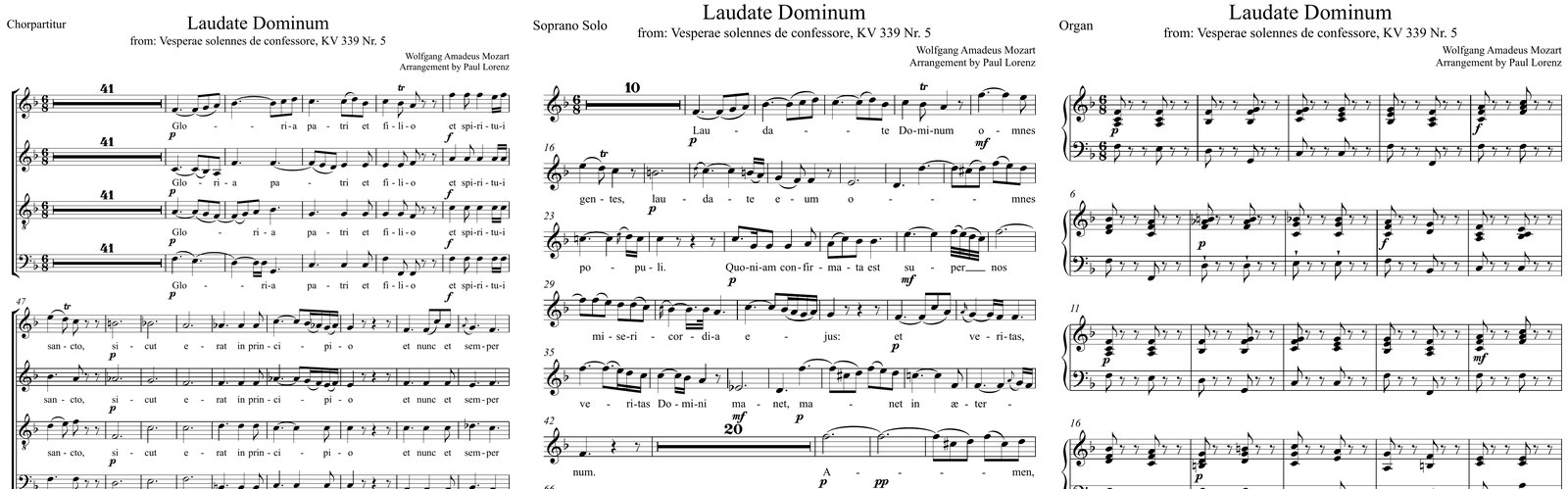
From the Complete Edition: the SATB choral score, the soprano solo part and the organ part.
What is in the 33 pages
| Section | Pages | For whom |
|---|---|---|
| Full score | 15 | Conductor — soloist, choir and all instruments |
| Choral score (SATB) | 2 | Choir director, rehearsal pianist |
| Soprano solo | 1 | The soloist — the whole psalm and the Amen |
| Soprano · Alto · Tenor · Bass | 1 each | Individual voice parts for the choir sections |
| Bassoon | 1 | Winds |
| Violin I | 2 | Strings — the melody of the introduction |
| Violin II | 3 | Strings — the rocking accompaniment figure |
| Violoncello | 2 | Strings — the bass line, marked Solo / Tutti |
| Organ | 3 | Organist — two staves |
The bookmarks panel of any PDF reader jumps straight to every part. The choral score appears there under its German name, “Chorpartitur”.
How the piece unfolds
| Bars | What happens |
|---|---|
| 1–10 | Orchestral introduction: the first violins present the melody over the second violins’ broken chords |
| 11–41 | Soprano solo — “Laudate Dominum omnes gentes … et veritas Domini manet in aeternum” |
| 42–62 | The choir enters piano with “Gloria Patri” on the opening melody |
| 63–72 | Soloist and choir together in the Amen; the piece fades out pianissimo |
Why Mozart’s Laudate Dominum is sung so often
Mozart set the shortest psalm as a single long-breathed melody: a soprano line in F major that rises and falls over a quietly rocking accompaniment, with hardly any drama and no display. When the choir takes over the melody for the Gloria Patri, the piece does not grow louder but more intimate, and the soloist’s final Amen floats above it. Five minutes long, for modest forces and with a choral part that a parish choir learns in one evening, it has become one of the standard pieces for feast days, weddings, funerals and concerts alike.
Programming the Laudate Dominum
The piece fits anywhere a quiet, radiant moment is wanted — as a meditation after Communion, at a wedding or a memorial service, or between larger works in a concert. It pairs naturally with Mozart’s Ave Verum Corpus, and choirs that already sing Mozart’s Coronation Mass KV 317 or Sparrow Mass KV 220 will find the same Salzburg idiom here. For a small ensemble with the same strings and organ, Haydn’s Little Organ Mass is a natural companion.
More repertoire for choir and church is in the sacred choral catalogue and the choir editions. If you need a transposition, an added instrument or a voicing adapted to the singers you actually have this season, ask before you buy — bespoke adaptation is part of what this publisher does.
Own this arrangement? Share your review →
Laudate Dominum (Vesperae solennes de confessore, KV 339) sheet music — frequently asked questions
What exactly is included in the Complete Edition?
One PDF of 33 pages: the full conductor’s score (15 pages), the SATB choral score (2 pages), the soprano solo part (1 page) and individual parts for Soprano, Alto, Tenor and Bass (1 page each), Bassoon (1 page), Violin I (2 pages), Violin II (3 pages), Violoncello (2 pages) and Organ on two staves (3 pages). PDF bookmarks take you straight to every part. The file is A4, print-ready and works on a tablet.
What is the instrumentation of Mozart’s Laudate Dominum?
Soprano solo, SATB choir, bassoon, Violin I, Violin II, a bass line and organ. There is no viola part — Salzburg church music of Mozart’s time was usually without violas. In this edition the bass line is the violoncello part; a double bass can read from the same part. The organ plays throughout.
Where does the Laudate Dominum come from?
It is the fifth of six movements of the Vesperae solennes de confessore, KV 339, which Mozart wrote in 1780 for Salzburg Cathedral — settings of the five vesper psalms and the Magnificat for the feast of a confessor saint. The Laudate Dominum sets Psalm 117 (116 in the Vulgate), the shortest psalm, followed by the doxology “Gloria Patri”. It is so often performed on its own that it is usually known simply as “Mozart’s Laudate Dominum”.
How long does it take to perform?
About five minutes. The tempo mark is Andante ma un poco sostenuto in 6/8; the piece has 72 bars.
How is the piece divided between soloist and choir?
After a ten-bar orchestral introduction the soprano soloist sings the whole psalm, “Laudate Dominum omnes gentes”. At bar 42 the choir enters piano with the doxology, “Gloria Patri”, on the melody of the opening, and from bar 63 the soloist rises above the choir in the Amen. The choir sings about thirty bars; the solo carries the rest.
How difficult is it?
The choral part is short, homophonic and quiet, and learns in a single rehearsal — the work goes into a sustained piano and a well-tuned F major. The solo needs a soprano with a calm legato line, secure breath control over long phrases and an easy top up to G; the Amen is the most exposed passage. The string, bassoon and organ parts lie comfortably for good amateur players.
Mozart is public domain — why buy this edition instead of a free scan?
Mozart’s music is public domain, and scans of old editions exist. What they do not give you is a performance library in one file: a full score, a choral score, a solo part, an individual part for every voice section, a bassoon part, two violin parts, a violoncello part and an organ part written out on two staves — freshly engraved and matching bar for bar. The realistic alternative is not a free download; it is an evening of copying and extracting parts before the first rehearsal.
Is the text in Latin?
Yes. Psalm 117 and the doxology are underlaid in Latin in the full score, the choral score, the solo part and each of the four voice parts.
Can we perform it with choir, soloist and organ alone?
The organ part contains the full harmony, so soloist, choir and organ can perform the Laudate Dominum when no strings are available — this is how it is often heard in services. The violins carry the accompaniment figure and the bassoon doubles the bass line; the piece sounds as Mozart wrote it only with them. If you need a different scoring, Paul Lorenz adapts the edition on request; please ask before you buy.
What licence do we get, and what is the refund policy?
Mozart’s composition is in the public domain, so no royalties are due for the work itself. This edition is published by Edition Zeitlos, Austria, and your purchase licenses you to print the parts for your own ensemble and to perform the piece with the purchasing ensemble in concert and liturgy — you own the file, there is no rental and no return deadline. Any reporting of the public performance to a performing-rights society (GEMA/AKM/SUISA, or ASCAP/BMI/PRS elsewhere) is handled by the organiser as usual. Because the complete file is delivered immediately, downloads cannot be refunded; please study the score previews on this page, and contact us for extended sample pages before buying if you would like to see more.
Can the edition be adapted?
Yes — bespoke adaptation is a core service of Paul Lorenz. Transpositions for a mezzo-soprano soloist, added or alternative instruments, a separate double-bass part or a voicing that fits the singers you have this season are available on request. Please get in touch before you buy.
Can I play the Soprano part on Clarinet in B♭?
Yes. The Part Configurator is included in the price: the Soprano part is also available for Flute, Oboe, Clarinet in B♭ and Soprano saxophone in B♭ and 5 more instruments – transposed, in the right clef, checked for range and breathing. You receive the link by e-mail after your purchase.
Which parts are available for other instruments?
4 instrumental parts and 4 choir voices for 18 instruments in all. The overview “Parts for your instrumentation” on this page lists every original part with its instruments. For a different instrumentation you can send Paul Lorenz a request after your purchase.
Can an instrument play one of the choir voices?
Yes. The choir voices are available as instrumental parts too – Alto for Cello, for example: transposed, in the right clef, without the lyrics, checked for range and breathing.
Is this edition available in another key?
Yes. The whole edition is also available in G major (original: F major) – score and all parts in the new key, as one PDF, included in the price. We only offer keys in which every part stays within its instrument’s range; where a single instrumental phrase would otherwise fall outside it, it is set an octave higher or lower. You choose the key in the Part Configurator after your purchase.
Am I allowed to use the re-scored parts?
Yes. Parts from the Part Configurator belong to the edition you bought and are covered by the same license – for your ensemble, with the same rights of use. Every part carries the notice “Licensed to …” in its footer. For public performances the organiser registers the performance with the collecting society as usual (e.g. PRS, ASCAP/BMI, GEMA).