Fauré Requiem Sheet Music — Soloists, Choir & Orchestra, Op. 48
The complete performance edition of Fauré’s Requiem in D minor — full score, choral score and all thirty-one individual parts for soprano and baritone soloists, SATB choir, orchestra and organ in one PDF. Edited by Paul Lorenz.
Regular price €119.00
Now
€89.90
Instant PDF download
See the score & buy
Edition facts
Requiem in D minor, Op. 48 by Gabriel Fauré, arranged by Paul Lorenz for SATB choir and orchestra with soprano and baritone soloists: full score (76 pages) and separate parts (277 pages), delivered as a PDF (A4) for instant download, €89.90.
- Instrumentation
- Flute (2), Clarinet (2), Bassoon (2) · Horn (4), Trumpet (2), Trombone (3) · Timpani · Harp, Organ · Violin, Viola (2), Cello (2), Double bass
- Choir
- SATB
- Soloists
- Soprano, baritone soloists
- Pages
- 353 pages — full score (76) + separate parts (277)
- Key
- D minor
- Duration
- approx. 35 min
- Difficulty
- Advanced (4/5)
- Tempo
- Molto largo – Andante moderato, ♩ = 40
- Edition
- 2026
- Format
- PDF, A4, instant download
Read from the PDF you download.
Gabriel Fauré’s Requiem in D minor, Op. 48 is the gentlest of the great Requiem settings — no Dies irae, but the Pie Jesu, the Agnus Dei and the In Paradisum. This edition presents the work for full orchestra, the version de concert published in 1900, in which the Requiem is sung by most choirs today. It is the complete performance edition by Paul Lorenz — conductor’s score, choral score and every individual part, delivered as one instant PDF download you own outright. Launch price €89.90 (regular price €119.00).
The edition is laid out for rehearsal and concert. Every singer gets an individual part as well as the choral score; the soprano solo of the Pie Jesu and the baritone solos of the Offertoire and the Libera me have parts of their own. Flutes, clarinets, bassoons, four horns, trumpets, trombones, timpani, harp, the strings with divided violas and cellos, and the organ, written out on two staves, each have their own part — 353 pages in one file, bookmarked by part and movement. All seven movements are included, with the Latin text underlaid in the score, the choral score and every voice part.
Choose your “Requiem in D minor, Op. 48” edition
Complete Edition — Full Score, Choral Score & All Parts
SATB choir and orchestra with soprano and baritone soloists · 353 pages: score + parts · PDF (A4)
One PDF, 353 pages: conductor’s score, SATB choral score and thirty-one individual parts — woodwind, horns, trumpets, trombones, timpani, harp, organ, soprano and baritone solo, Soprano, Alto, Tenor, Bass, violins, violas, cellos and double bass.
- Instant PDF download
- Secure checkout
- Licensed edition
Quality in detail
- Everything in One PDF: Full score, SATB choral score and thirty-one individual parts for all seven movements — 353 pages in a single download, with PDF bookmarks for every part and every movement. Print the pages you need; there is no hire material to order or return, and the file is yours to keep for every performance.
- The Orchestral Version of 1900: Fauré first wrote the Requiem for a small ensemble built on violas, cellos, harp and organ; the version de concert of 1900 adds a full complement of woodwind, brass and violins. This edition follows that full orchestral version, bar for bar — the Requiem as it is heard in most concerts and on most recordings.
- Fauré’s Orchestra, Part by Part: Two flutes and two clarinets in B-flat for the Pie Jesu, two bassoons, four horns in F, two trumpets in B-flat, three trombones and timpani for the Libera me, harp, violins, two viola parts, two cello parts and double bass — every player has a part with all seven movements, and a tacet page wherever the instrument is silent.
- The Organ Written Out: The organ plays almost throughout and holds the harmony together. Its part is written out on two staves, 22 pages — no figured bass to realise.
- Soloists with Their Own Parts: The soprano solo of the Pie Jesu and the baritone solos of the Hostias and the Libera me are printed in the full score and as separate solo parts, so the soloists do not need to read from the choral score.
- Freshly Engraved: New engraving in A4 with consistent layout, movement titles, tempo marks with Fauré’s metronome figures and bar numbers at the start of every system in score and parts — print-ready and comfortable on a tablet. The source is the first printed full score of the 1900 version, checked bar by bar against the historical set of orchestral parts and the vocal score.
Fauré’s Requiem sheet music at a glance
| Work | Requiem in D minor, Op. 48 — Gabriel Fauré, version for full orchestra published in 1900; public domain |
| Movements | 7 — Introït et Kyrie · Offertoire · Sanctus · Pie Jesu · Agnus Dei · Libera me · In Paradisum |
| Duration | approx. 35 minutes |
| Voicing | SATB choir (tenors and basses divided in the Introït) with soprano solo (Pie Jesu) and baritone solo (Offertoire, Libera me) |
| Instrumentation | 2 flutes, 2 clarinets in B-flat, 2 bassoons, 4 horns in F, 2 trumpets in B-flat, 3 trombones, timpani, harp, organ, violins, violas (2 parts), cellos (2 parts), double bass |
| What you receive | One PDF, 353 pages: full score (76 pages), choral score (25 pages), thirty-one individual parts — bookmarks for every part and movement |
| Text | Latin |
| Edition | Paul Lorenz — arrangements recorded with the London Symphony Orchestra at Abbey Road Studios |
| Format | High-resolution PDF, A4 — instant download, print-ready and tablet-friendly |
| Licence | Public-domain work; edition © 2026 Edition Zeitlos, Austria. Print for your ensemble, perform in concert and liturgy — no rental, no return deadline |
| Price | €89.90 launch price (regular €119.00) |
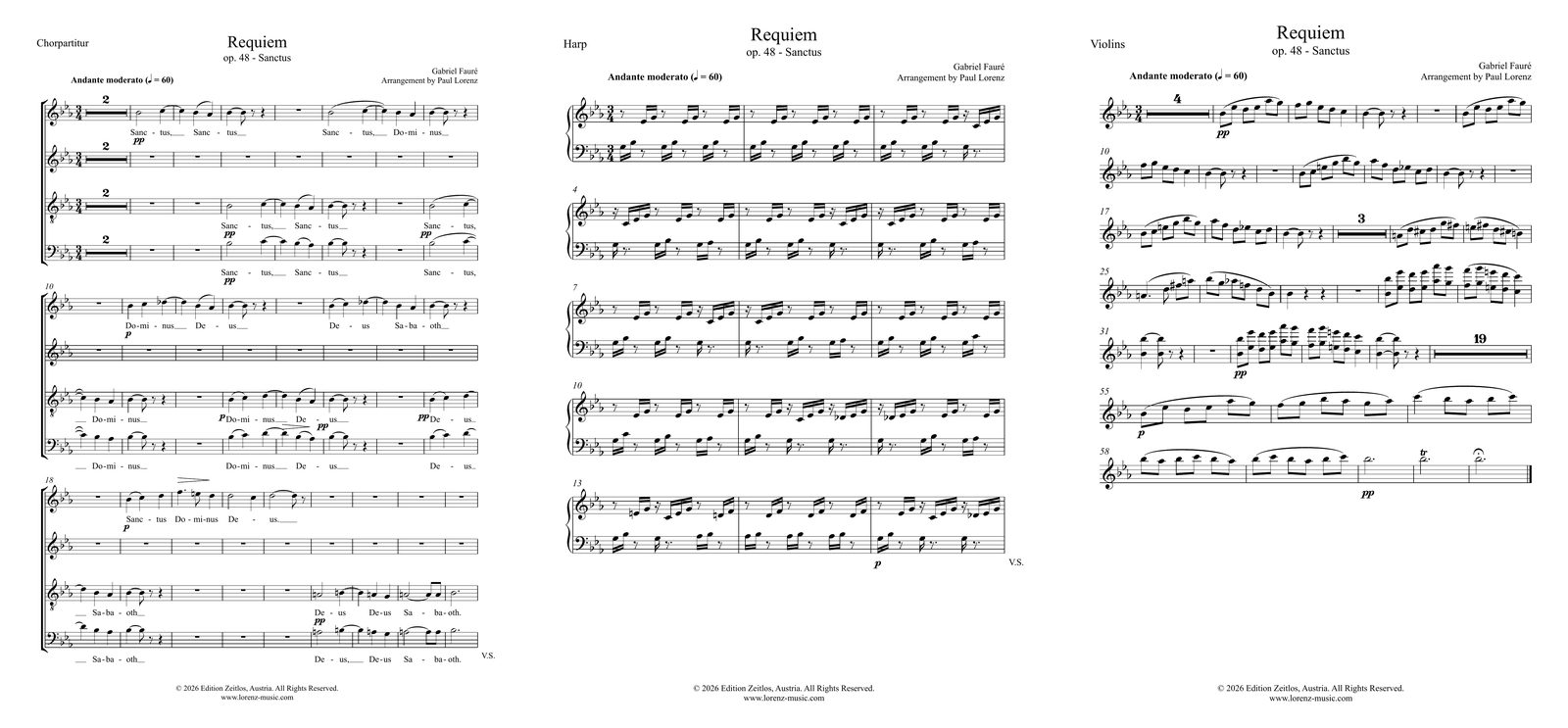
From the Complete Edition: the SATB choral score, the harp part and the violin part — opening of the Sanctus.
What is in the 353 pages
| Section | Pages | For whom |
|---|---|---|
| Full score | 76 | Conductor — all voices and instruments, every movement |
| Choral score (SATB) | 25 | Choir director, rehearsal |
| Flute 1 · 2 · Clarinet in B-flat 1 · 2 | 7 each | Woodwind — they play in the Pie Jesu |
| Bassoon 1 · 2 | 7 each | Woodwind — Introït, Pie Jesu, Agnus Dei |
| Horn in F 1 · 2 · 3 · 4 | 7 each | Brass — Introït, Sanctus, Agnus Dei, Libera me |
| Trumpet in B-flat 1 · 2 | 7 each | Brass — Introït and Sanctus |
| Trombone 1 · 2 · 3 · Timpani | 7 each | Libera me |
| Harp | 10 | Sanctus, Pie Jesu, In Paradisum |
| Organ | 22 | Written out on two staves |
| Soprano Solo · Baritone Solo | 1 · 2 | Pie Jesu · Offertoire and Libera me |
| Soprano · Alto · Tenor · Bass | 8 · 9 · 11 · 8 | Individual voice parts |
| Violins | 9 | One part for first and second violins, as in Fauré’s score |
| Viola 1 · 2 · Violoncello 1 · 2 | 13 · 13 · 12 · 12 | Divided violas and cellos |
| Double Bass | 10 |
Every part contains all seven movements in order, with a tacet page wherever the instrument is silent. The bookmarks panel of any PDF reader jumps straight to, say, Harp → In Paradisum. The parts carry their English names in the file (Horn in F, Trumpet in B-flat, Violoncello); the choral score appears under its German name, “Chorpartitur”.
The seven movements
| Movement | Tempo and metre in this edition | Bars | Character |
|---|---|---|---|
| Introït et Kyrie | Molto largo · 4/4 — Andante moderato | 91 | A hushed opening on one chord, then the tenors’ melody over flowing violas and cellos |
| Offertoire | Adagio molto · 4/4 — Andante moderato · 3/4 — Tempo I · 4/4 | 95 | Canon of altos and tenors, the baritone solo “Hostias”, and a quiet Amen |
| Sanctus | Andante moderato · 3/4 | 62 | Violins over harp arpeggios, rising to a Hosanna with horns and trumpets |
| Pie Jesu | Adagio · 4/4 | 38 | Soprano solo with organ, harp and soft woodwind |
| Agnus Dei | Andante · 3/4 — Molto largo · 4/4 — Tempo I · 3/4 | 94 | A long tenor line, the Lux aeterna, and the return of the opening |
| Libera me | Moderato · 2/2 — Più mosso · 6/4 — Moderato · 2/2 | 136 | Baritone solo, then the Dies illa with full brass and timpani |
| In Paradisum | Andante moderato · 3/4 | 61 | Sopranos over the organ’s rippling semiquavers, closing in D major |
The Requiem of the 1900 concert version
Fauré’s Requiem grew over more than ten years: a first version with five movements for a chamber ensemble in 1888, the Offertoire and the Libera me added by 1893, and the version for full orchestra published in 1900. It is this last version that made the work famous, and the one this edition presents complete, in the order of the liturgy — for a concert or for a Requiem Mass.
Programming the Requiem
At about thirty-five minutes Fauré’s Requiem fills half a concert. It pairs naturally with other music of consolation — Barber’s Agnus Dei or Mozart’s Ave Verum Corpus — and it is often heard together with Mozart’s Requiem, the great D minor Requiem of the eighteenth century.
More repertoire for choir and church is in the sacred choral catalogue and the choir editions. If you need separate violin parts, a reduced orchestra or a version for the players you have, ask before you buy — bespoke adaptation is part of what this publisher does.
Own this arrangement? Share your review →
Requiem in D minor, Op. 48 sheet music — frequently asked questions
What exactly is included in the Complete Edition?
One PDF of 353 pages with all seven movements: the full conductor’s score (76 pages), the SATB choral score (25 pages), and individual parts for Flute 1 and 2, Clarinet in B-flat 1 and 2, Bassoon 1 and 2, Horn in F 1 to 4, Trumpet in B-flat 1 and 2, Trombone 1, 2 and 3, and Timpani (7 pages each), Harp (10), Soprano Solo (1), Baritone Solo (2), Soprano (8), Alto (9), Tenor (11), Bass (8), Violins (9), Viola 1 and 2 (13 each), Violoncello 1 and 2 (12 each), Double Bass (10) and Organ (22). PDF bookmarks take you straight to every part and movement. The file is A4, print-ready and works on a tablet.
Which version of the Requiem is this?
The version for full orchestra published in 1900, the one most choirs perform today. Fauré’s earlier versions of 1888 and 1893 use a smaller ensemble built on violas, cellos, harp and organ; the 1900 score adds a full complement of woodwind, brass and violins. The seven movements, the choral parts and the solos are the same.
What is the instrumentation?
Soprano and baritone soloists, SATB choir, 2 flutes, 2 clarinets in B-flat, 2 bassoons, 4 horns in F, 2 trumpets in B-flat, 3 trombones, timpani, harp, organ, violins, violas in two parts, cellos in two parts and double bass. Many instruments play only in some movements: flutes and clarinets only in the Pie Jesu, trombones and timpani only in the Libera me, trumpets in the Introït and the Sanctus, and the violins are silent in the Introït, the Offertoire and the Pie Jesu. Fauré’s score writes the trumpets in F; this edition gives them in B-flat.
Do we need soloists?
Yes, two — a soprano for the Pie Jesu and a baritone for the Hostias in the Offertoire and the opening of the Libera me. Both solo parts are printed separately.
Is there a piano reduction or a version for choir and organ?
The 25-page choral score contains the four choir staves without a piano reduction. A separate edition for choir and organ is in preparation; in the meantime the organ part of this edition carries the harmony almost throughout, but in the opening of the Introït and a few other bars the organ is silent while the orchestra plays. If you need a version for your forces now, please ask before you buy.
How long does the Requiem take to perform?
About 35 minutes for all seven movements, depending on tempo. Fauré’s metronome marks are printed in the edition.
How difficult is it?
The Requiem is not virtuosic, but it is demanding in a different way — long, quiet lines that have to stay in tune, the tenors and basses divided in the Introït, a wide dynamic range from the hushed opening to the fortissimo of the Libera me, and phrasing that carries over the bar line. The Pie Jesu asks a soprano with perfect calm, the baritone solos a warm, sustained voice. The orchestral parts suit capable amateur and professional players.
Fauré is public domain — why buy this edition instead of a free scan?
The Requiem is public domain, and scans of old editions exist. What they do not give you is a performance library in one file: a score, a choral score and an individual part for every voice section and every instrument — freshly engraved and matching bar for bar. The first printed full score puts the wind in pairs on one staff, prints the trumpets in F and gives no bar numbers. The realistic alternative is not a free download; it is hire material or evenings of extracting parts before the first rehearsal.
Is the text in Latin?
Yes. The complete Latin text is underlaid in the full score, the choral score, the two solo parts and each of the four voice parts.
What licence do we get, and what is the refund policy?
The Requiem is in the public domain, so no royalties are due for the work itself. This edition is published by Edition Zeitlos, Austria, and your purchase licenses you to print the parts for your own ensemble and to perform the Requiem with the purchasing ensemble in concert and liturgy — you own the file, there is no rental and no return deadline. Any reporting of the public performance to a performing-rights society (GEMA/AKM/SUISA, or ASCAP/BMI/PRS elsewhere) is handled by the organiser as usual. Because the complete file is delivered immediately, downloads cannot be refunded; please study the score previews on this page, and contact us for extended sample pages before buying if you would like to see more.
How long is the launch price valid?
The Complete Edition is offered at €89.90 for its launch instead of the regular €119.00. Buy now and the file is yours at that price — including every future correction of this edition, which you can download again from your order page.
Can the edition be adapted?
Yes — bespoke adaptation is a core service of Paul Lorenz. Separate parts for first and second violins, trumpets in another key, transpositions or a reduced orchestra for the forces you actually have are available on request. Please get in touch before you buy.