Kempter’s Pastoral Mass in G: A Conductor’s Guide for Choir Directors and Church Musicians
Seventeen minutes of Christmas in G major — what the Pastoral Mass asks of your choir, which forces you really need, and how to prepare it safely in time for Midnight Mass.
Kyrie to Dona nobis pacem
Calculated from the metronome marks
in Augsburg
Part of Bavarian Christmas music ever since
choir + organ, + strings, + winds
The same choir parts in all three
There are works you perform, and works a congregation waits for. In many churches in Bavaria and Austria, Karl Kempter’s Pastoral Mass in G belongs to the second kind: when the Kyrie begins to rock in 6/8 at Midnight Mass, Christmas has arrived for a good part of the people in the pews. That is a gift for any church musician — and an obligation, because those people know exactly how the mass should sound.
I have performed the Pastoral Mass on numerous occasions with orchestra, choir and soloists. What follows is what I would have liked to know before planning it: what the work is, which forces you actually need, how to prepare it between October and Christmas Eve, and how to recognise performance material that will not cost you evenings in December.
Karl Kempter’s Pastoral Mass in G major, Op. 24, is a Christmas mass of about 17 minutes in six movements, first performed in Augsburg on 24 December 1851. It is written for SATB choir with solos, strings and organ; library catalogues of the original list the flute, clarinets, horns, trumpets and timpani as non-obligatory. It therefore works with choir and organ alone as well as with full orchestra. You do not need to hire soloists — the solos sit in the choir staves. Spend your rehearsal time on the Credo with its tempo changes and on a light, dancing 6/8 in the Kyrie, Sanctus and Benedictus.
What the Pastoral Mass is
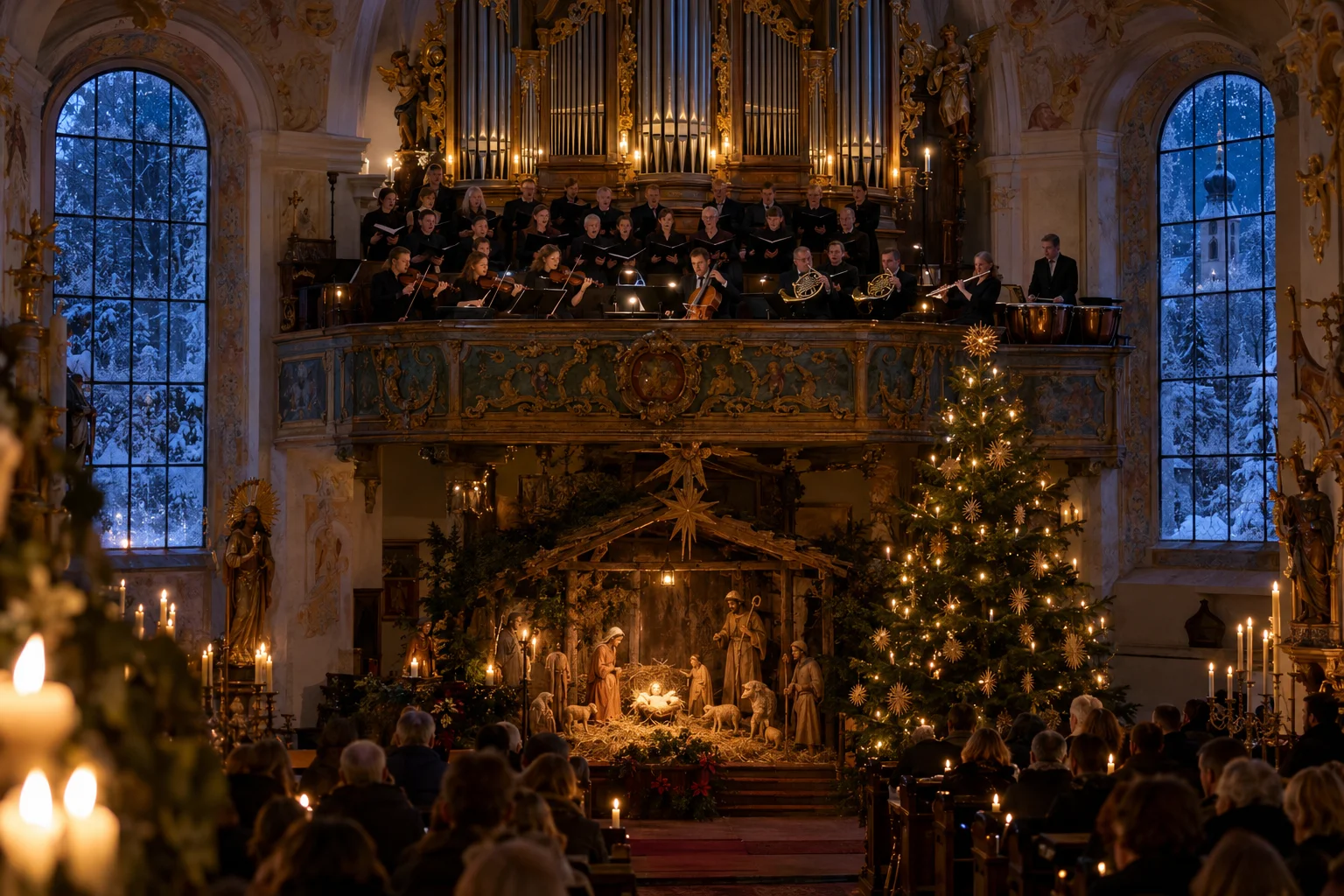
The Pastoral Mass in G major, Op. 24, is a Christmas mass by the Augsburg church musician Karl Kempter (1819–1871). It sets the complete Latin Ordinary in six movements lasting about 17 minutes in total, was first performed in Augsburg on Christmas Eve 1851, and has been part of Christmas church music in Bavaria ever since.
Kempter served Augsburg Cathedral as organist for decades and became its cathedral music director in 1865 — so he knew very precisely what a good church choir can and cannot deliver on a feast day. You can hear that experience in the mass. The choral writing is largely homophonic and singable, the solos are short, and the instruments colour rather than dominate.
Kempter wrote a large amount of church music; none of it has stayed as alive as Op. 24. That is not because of its difficulty but because of its tone. The Pastoral Mass sounds of the manger, the shepherds and a winter night — and it does so without ever tipping into sentimentality.
What makes a “Pastoral Mass”
A Pastoral Mass is a Christmas mass in the musical language of the shepherds: the rocking 6/8 of a cradle song, drone basses like a bagpipe or hurdy-gurdy, melodies in parallel thirds and sixths. The genre flourished in Catholic southern Germany and Austria from the eighteenth century onwards.
In Kempter’s mass the shepherds’ idiom is easy to point to in three places. The Kyrie is in 6/8, Andante, G major, with flute and strings over a calm bass. The Sanctus opens over a held drone of G and D in the low strings before breaking into a jubilant Allegro Hosanna. And the Benedictus rocks in 6/8 in D major, carried by the solo voices.
Movement by movement
The six movements last roughly: Kyrie 2½ minutes, Gloria 4½, Credo 4½, Sanctus 1, Benedictus 1½, Agnus Dei 2½. The Credo needs the most rehearsal time, the Agnus Dei the most shaping.
| Movement | Tempo · key · metre | Approx. | What it asks of you |
|---|---|---|---|
| Kyrie | Andante, ♩ = 80 · G major · 6/8 | 2½ min | The rocking 6/8 and clean solo entries. The solo voices answer the choir — they must be secure or the dialogue falls apart. |
| Gloria | Allegro, ♩ = 120 · G major · 4/4 | 4½ min | Bright and festive, solo and tutti alternating in all four voices. Diction before beauty of tone — the text carries the movement. |
| Credo | Allegro moderato · G major · 2/2 — Andante, E-flat major, 4/4 — Tempo I | 4½ min | The movement that gets the extra rehearsal: two tempo changes, a hushed Et incarnatus est in E-flat major and the return to Allegro at Et resurrexit. |
| Sanctus | Andante, ♩ = 80 · G major · 6/8 → Allegro, 4/4 | 1 min | The drone in the bass needs calm and intonation; then the change of metre into the Hosanna without hesitation. |
| Benedictus | Allegretto, ♩ = 100 · D major · 6/8 | 1½ min | Lyrical and light, carried by the solo voices — the moment for your solo quartet. |
| Agnus Dei | Andante, ♩ = 80 · G minor → G major | 2½ min | A pleading G minor that brightens into the G-major Dona nobis pacem. Everyone in the church should hear that change of light. |
I calculated the timings from the printed metronome marks in my edition; with ritardandi and breathing space you arrive at about seventeen minutes. That fits into Midnight Mass without cutting anything else.
Which forces do you really need?
The minimum is an SATB choir and an organist. With strings you get the warm core of the work; with flute, clarinets, horns, trumpets and timpani the full pastoral colour and festive brilliance. All three levels use the same choir parts.
| Level | Scoring | Best for | Rehearsal effort |
|---|---|---|---|
| Minimum | SATB choir + organ | A second Christmas service, small churches, the whole rehearsal phase | Choir only |
| Core | + Violin I & II, viola, cello, double bass | Christmas Day, St Stephen’s Day, smaller parish churches | One string rehearsal, one joint |
| Festive | + flute, 2 clarinets, 2 horns, 2 trumpets, timpani | Midnight Mass, Christmas Day high mass, Christmas concert | One joint rehearsal with everyone, kept short |
This ladder is not a modern invention. Library catalogues of Kempter’s original list the strings and organ as obligatory and the flute, clarinets, horns, trumpets and timpani as non-obligatory. That is exactly how the mass has always been performed in practice: with the musicians you can get at Christmas.
So plan the ladder deliberately. A choir that rehearses from a choral score with a written-out organ part can perform the mass at the minimum level at any time. A horn player down with flu on 24 December then costs you the colour, not the performance.
Do you need soloists?
No. Kempter writes the solos inside the four choir voices and marks them “Solo” and “Tutti”; there are no separate solo movements. A quartet drawn from your own choir is the traditional and practical solution.
Solos appear in the Kyrie, Gloria, Credo, Benedictus and Agnus Dei — in the Gloria in all four voices. They are short; the challenge is a confident entry out of the choral sound, not stamina. Choose your four solo voices by the third rehearsal at the latest, so they sing their passages several times in context.
If you can engage four soloists, it adds brilliance to Midnight Mass. It is not necessary.
A rehearsal plan to Christmas Eve
An experienced church choir prepares the Pastoral Mass in four rehearsals of ninety minutes plus one joint rehearsal with the instrumentalists. Starting in October leaves a buffer for illness, Advent commitments and everything else December brings.
| Rehearsal | Focus | Outcome |
|---|---|---|
| 1 | Kyrie and Sanctus — the 6/8 feel, Latin pronunciation | Both pastoral movements sung through; pronunciation agreed |
| 2 | Gloria — text and solo/tutti changes | Diction at performance tempo; tutti entries after the solos secure |
| 3 | Credo in sections, choose the soloists | Both tempo changes secure; Et incarnatus est quiet and shaped |
| 4 | Benedictus and Agnus Dei, run-through with organ | The whole mass performable at the minimum level |
| Joint | Balance, entries and tempos with the instruments | Ready to perform; keep it to ninety minutes |
Settle Latin pronunciation in the first rehearsal and never return to it. German church Latin and Italianate Latin are both defensible; a choir singing half of one and half of the other is not.
Where it belongs in the church year
Liturgically the Pastoral Mass is the natural choice for Midnight Mass and the Christmas Day high mass, and it fits the whole Christmas season through St Stephen’s Day and New Year to Epiphany. In concert, at about seventeen minutes, it makes the first half of an Advent or Christmas programme.
Around the mass you need carols the congregation knows. Silent Night for SATB choir closes Midnight Mass in many churches, and Maria durch ein Dornwald ging is the quiet Advent tone before it. For a full concert, I have described running orders in the guide to programming a Christmas choir concert.
Once your choir knows the Pastoral Mass, Mozart’s Sparrow Mass is the natural next step for Easter — similar length, similar forces, but an entirely different, brilliant C-major tone. The conductor’s guide to it is Performing Mozart’s Sparrow Mass.
Choosing the right edition
Kempter’s music is in the public domain; performance material is not. Printed material for this mass is traditionally sold as separate items — score, choral scores, wind set, string set — and delivered by post. Check five things before you decide.
| Check | Why it matters |
|---|---|
| Score and all parts from one source? | Material from different editions has different bar numbers, rehearsal letters and page turns. That costs time in every joint rehearsal. |
| Choral score with the organ written out? | Only then can the organist accompany the mass alone — and only then does the choir rehearse from the same pages it performs from. |
| Individual voice parts? | A single-line Soprano, Alto, Tenor or Bass part is what singers practise from at home — especially with little time before Christmas. |
| Solo and tutti marked? | When the solos come from the choir, every singer must see where the quartet sings alone and where everyone comes back in. |
| Available instantly, printable as often as needed? | If you are planning in October you cannot wait weeks for music — and next year you will need a complete set again. |
Our edition of the Pastoral Mass is set up around exactly these points: conductor’s score, all 19 parts including separate voice parts, an SATB choir score and a choral score with the complete organ part on the page, solos marked, as an instant download. It is the material I conduct from.
Frequently asked questions
How long is Kempter’s Pastoral Mass?
About 17 minutes for the complete Ordinary, calculated from the printed metronome marks: Kyrie about 2½ minutes, Gloria 4½, Credo 4½, Sanctus 1, Benedictus 1½ and Agnus Dei 2½. It fits into a Midnight Mass or Christmas Day high mass without cutting anything else.
What is the scoring of the Pastoral Mass?
Library catalogues list Kempter’s original for SATB soloists and choir, strings and organ, with flute, two clarinets, two horns, two trumpets and timpani as non-obligatory. Modern performance editions such as Paul Lorenz’s provide separate parts for Violin I and II, viola, cello and double bass and a written-out organ part.
Do you need soloists for the Pastoral Mass?
Not hired ones. The solos sit in the four choir staves and are marked “Solo” and “Tutti”; a quartet from your own choir is the traditional and practical solution. Engaged soloists add brilliance at Christmas, but their absence never prevents a performance.
Can the Pastoral Mass be performed with choir and organ only?
Yes. With a choral score that carries the complete organ part on the same page, choir and organist can perform the whole mass alone — ideal for the second service of the day, a small church or the rehearsal phase. Strings and winds expand the same material without changing anything in the choir parts.
How difficult is the Pastoral Mass?
Intermediate. The choral writing is largely homophonic, the tempos range from Andante to Allegro, and the solos are short. The real work lies in the light 6/8 of the Kyrie, Sanctus and Benedictus, the tempo changes of the Credo and confident solo entries.
When is the Pastoral Mass performed?
Traditionally at Midnight Mass on Christmas Eve and the high mass on Christmas Day, and throughout the Christmas season up to Epiphany. It was first performed in Augsburg on 24 December 1851. In concert it works as the first half of an Advent or Christmas programme.
Is Kempter’s Pastoral Mass in the public domain?
Yes — Karl Kempter died in 1871, his composition is in the public domain and no royalties are due for the work itself. Modern editions are protected independently: the engraving and prepared parts belong to their publisher, and your right to print and perform comes with the edition you buy.
How many rehearsals does the Pastoral Mass need?
An experienced church choir manages it in about four rehearsals of ninety minutes plus one joint rehearsal with the instrumentalists. Starting in October leaves enough buffer before Christmas Eve.