Choir Rehearsal Tracks: How to Learn Your Part at Home
Rehearsal is for the sound of the choir, not for learning notes. How to learn your part between rehearsals — in four stages, with a plan for the last four weeks before the concert.
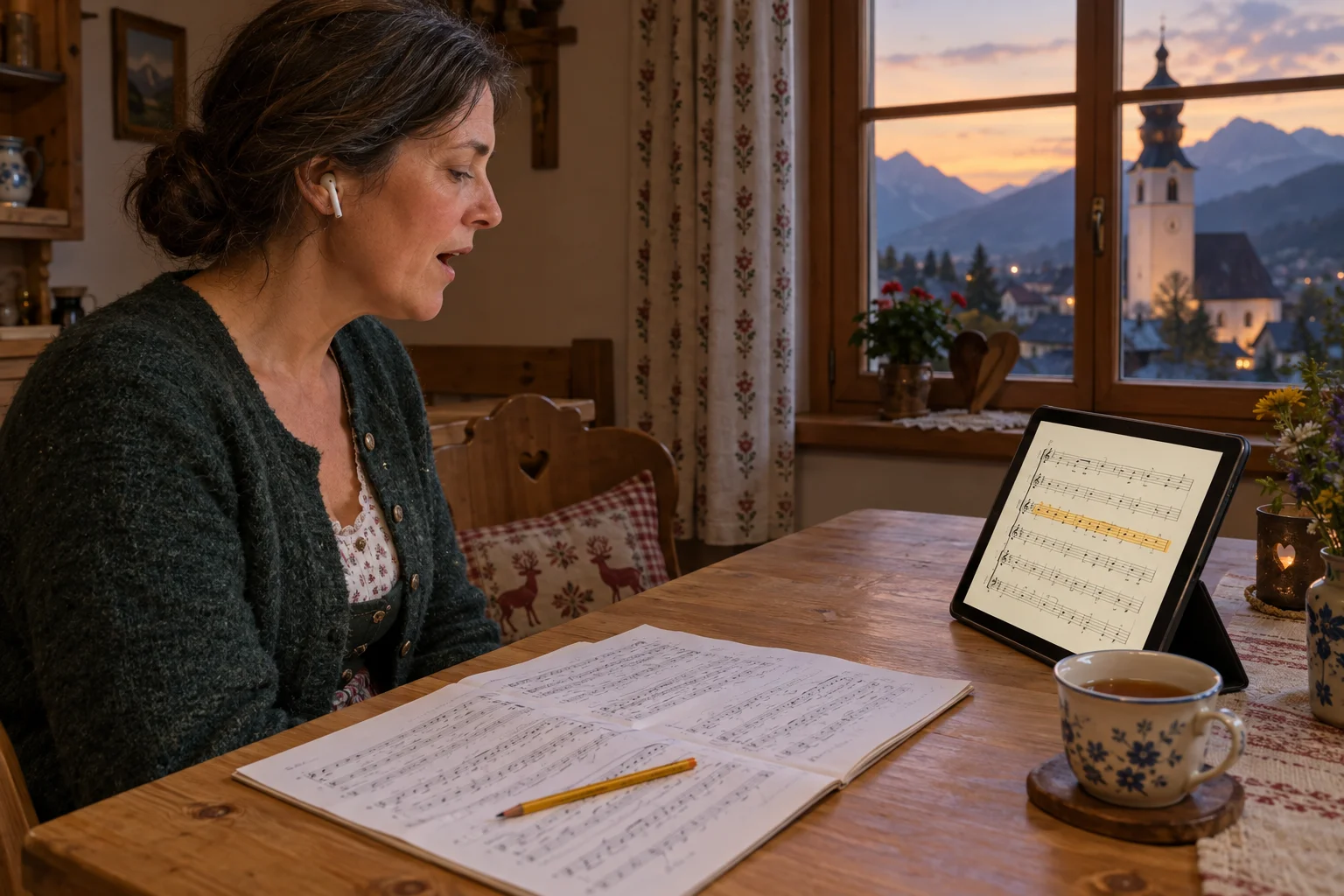
Practise your choir part in short sessions of fifteen to twenty minutes on several days a week — and in four stages: listen and follow the score, sing along with your part as support, sing against the other voices without it, and finally sing at full tempo with the accompaniment. Work on hard bars slowly and in a loop instead of starting from the top every time. The most useful rehearsal tracks are the ones you can mix yourself, slow down without changing pitch, and read along with.
Why practising at home makes the difference
In rehearsal the choir works on blend, balance, diction and shaping. When notes have to be taught there, the rest of the choir waits — and the time for what can only be done together runs short.
Every choir director knows the moment when one section hears a passage played on the piano for the third time while the other three sit and wait. Singers who arrive knowing their notes make rehearsal better for everyone: the choir works on the music, not the notes. It is more relaxed for you, too — a singer who is secure sings more freely and listens more to the others.
The four practice stages
Don't learn a part in one go. Learn it in four stages that build on each other, and move on only when the previous one is secure.
1. Listen and follow. Hear your part clearly with the accompaniment soft in the background, and follow the score. You learn melody, rhythm and words at the same time — and where your part rests. You don't need to sing yet; humming along is fine.
2. Sing with support. Now sing along while your part plays softly and helps where you are unsure. Watch the entries after rests: that is where most mistakes happen in rehearsal.
3. Alone against the other parts. Mute your part and sing it against the other three and the accompaniment. This is the real test — especially for altos and tenors, whose line often sits between the others.
4. At full tempo. Only at the end do you sing the section at the intended speed. Practise fast too early and you memorise the inaccuracies, which are hard to undo later.
Which kind of rehearsal track helps with what
There are three common ways to learn a part at home. They differ mostly in how much you can control yourself.
| Practice aid | Good for | Limit |
|---|---|---|
| Piano, played yourself | Checking the notes of a passage, finding your starting note | Needs piano skills; no accompaniment, no other voices |
| Learning tracks (MP3/CD) | Hearing your part any time, also on the go | A fixed mix at one tempo; your own part cannot be muted |
| Practice app with score | Mixing the voices yourself, slowing down, loops, following the score | Only for the works the app offers; needs internet |
For the four stages you need two things above all: switching your own part on and off, and lowering the tempo without the pitch shifting. A fixed learning track can't do that — it is still a good help for stages 1 and 2.
A practice plan for the last four weeks
Four weeks before the concert are enough for a work of moderate difficulty if you practise briefly on four or five days a week.
| Week | Goal | How to practise |
|---|---|---|
| 4 weeks before | Overview | Hear the whole work with your part clearly and follow the score; mark the hard passages |
| 3 weeks before | Secure notes | Sing section by section with support; marked passages slowly in a loop |
| 2 weeks before | Independent | Mute your own part and sing against the others; target the entries after rests |
| Concert week | Full tempo, with expression | Whole movements at full tempo with the accompaniment; dynamics and words, and save your voice |
Tips for every voice
Soprano: your line often carries the melody; the risk is in the high notes. Practise high passages softly and slowly first, then at full volume — the top stays free instead of pushed.
Alto: you often sing in the middle of the texture, frequently a third below the sopranos. Practise your part against the soprano line so you don't drift into their melody.
Tenor: tenor parts are usually written in the octave treble clef (with a small 8 below) — you sing an octave lower than written. Hear your part as it sounds and the reading soon feels natural.
Bass: you are the foundation of the harmony, and the whole choir tunes to you. Practise with the accompaniment alone as well, so you hold the root securely.
Between rehearsals: the Paul Lorenz Masterclass
For the works I publish as sheet-music editions there is the Paul Lorenz Masterclass: a rehearsal app in the browser built around exactly these four stages. You hear your part with the accompaniment of the work and every other choir part — each sung, on the piano or off — while the score follows the music with your part highlighted. Slow the tempo anywhere from 50 to 100 % without changing pitch, and loop the bars that aren't secure yet.
It is currently available for works including Mozart’s Coronation Mass, Handel’s Hallelujah Chorus and Barber’s Agnus Dei; every product page has a free demo of the opening. One access costs a one-off €9.90 per work — no subscription — and choirs get packs from €3.50 per singer.
Frequently asked questions
How long should I practise my choir part each day?
Fifteen to twenty minutes on four or five days a week does more than one long session the night before rehearsal. Notes and words settle in between sessions, so short, regular repetition beats volume.
Can I learn my part if I don't read music well?
Yes. Most choir singers learn their part by ear and use the score as a map. What matters is hearing your part clearly while you follow the notes — sound and page connect, and you read more confidently with every work.
Are learning tracks enough?
They are a good start, because you can hear your part whenever you like. Their limit is the fixed mix — usually your part louder and the rest softer, at one tempo. For the hard passages you then miss a slower tempo, a loop, and the chance to mute your own part and sing against the others.
How do I practise singing against the other parts?
In two steps: first sing with your own part playing softly in the background as support, then without it — only the accompaniment and the other voices. Start with short sections and lower the tempo until your entries are secure.
Are there rehearsal tracks for masses like Mozart's Coronation Mass?
Yes. The Paul Lorenz Masterclass is a rehearsal app in the browser for choir singers, with works including Mozart's Coronation Mass and Sparrow Mass, Kempter's Pastoral Mass, Handel's Hallelujah Chorus and Barber's Agnus Dei. You practise your part with the accompaniment of the work and every other choir part while the score follows the music; one access costs a one-off €9.90 per work, and choirs get packs from €3.50 per singer.