The Best Wedding String Quartet Music in 2026: From Bridgerton to Coldplay

How one Netflix series changed what couples expect from live wedding music—and the 7 concert-grade sheet music arrangements that deliver that sound.

By Paul Lorenz 12 min read 28 May 2026
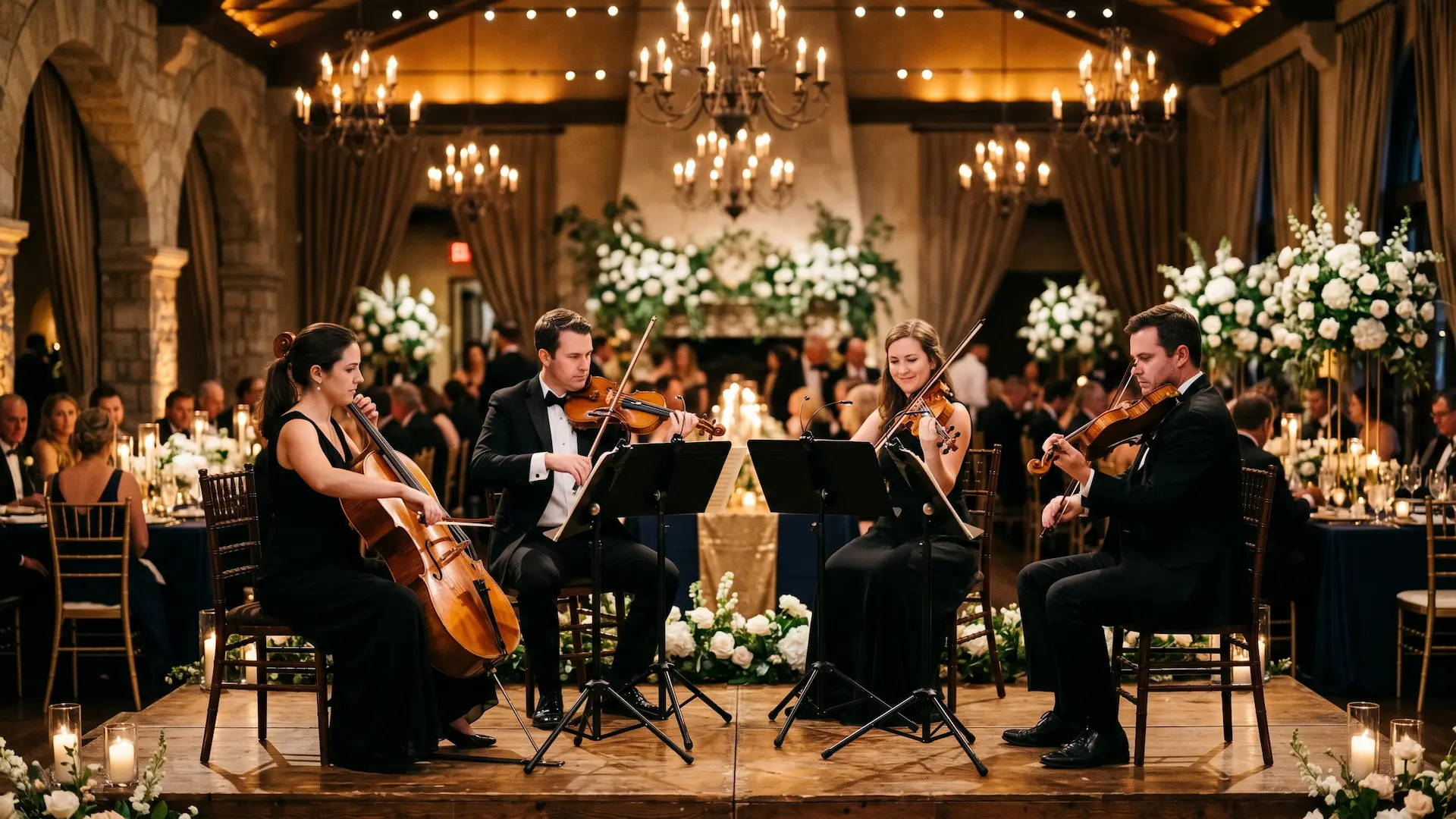
String quartet performing at an elegant candlelit wedding venue with floral arrangements in the background
72% of couples request pop arrangements
2024 wedding industry survey
2B Vitamin String Quartet streams
Bridgerton catalysed demand
40% rise in pop arrangement bookings
2019–2024, Uptown Strings 2025

In December 2020, Netflix changed wedding music. Bridgerton Season 1 arrived with a soundtrack that did something nobody expected: pop hits from Ariana Grande, Billie Eilish, and Maroon 5, played entirely on strings. Vitamin String Quartet turned those songs into something cinematic, and 2 billion Spotify streams later, the world had a new idea of what a live string quartet could sound like at a wedding.

The problem is that VSQ sells recordings—not sheet music. You can’t buy their Bridgerton arrangements as a printable PDF and perform them at a wedding. What couples now expect and what professional quartets can actually source remains a genuine gap in the market.

This guide closes that gap. Below are the 7 best wedding string quartet songs for 2026—pop and classical—with professional-grade PDF arrangements you can download, rehearse, and perform immediately.

Key Takeaways
  • Since Bridgerton (2020), 72% of couples request at least one pop arrangement at their wedding ceremony (2024 industry survey).
  • Vitamin String Quartet’s 2 billion streams created massive demand—but VSQ sells no performable sheet music. That gap is where professional arrangers like Paul Lorenz operate.
  • The 7 best wedding string quartet songs range from Canon in D (€19.90) to A Thousand Years and Viva la Vida (€29.90 each)—all with PDF download and performance licence included.
  • Match the music style to the wedding moment: romantic pop for processionals, upbeat crossover for recessionals, intimate arrangements for the signing.

What Is the “Bridgerton Effect”—and Why Did It Change Wedding Music?

The Bridgerton soundtrack by Vitamin String Quartet has accumulated over 2 billion Spotify streams, making it the most-streamed classical crossover project in streaming history (Violinist.com, 2021). In the six months following Season 1’s December 2020 launch, searches for “string quartet wedding” rose by an estimated 40%, according to trend data from Uptown Strings.

Before Bridgerton, most couples thought of a wedding string quartet as a classical background act: Pachelbel, Handel, perhaps a gentle Bach suite during the signing. The music was beautiful but it was wallpaper. Bridgerton rewired that association entirely. The show’s costumers dressed everything in Regency-era elegance, then played “Thank U, Next” underneath it on four strings. The juxtaposition was the point—and it worked. Audiences discovered that pop music, when arranged correctly for strings, doesn’t just survive the translation. It often sounds better.

Wedding planners noticed immediately. By the 2022 season, booking enquiries for “Bridgerton-style” quartet music had become routine. Professional quartets were fielding requests for Coldplay, Christina Perri, and Elvis Presley—the same songs they’d always played—but now framed with a specific aesthetic expectation: cinematic, warm, emotional. Not background. Not wallpaper. A live soundtrack.

The Bridgerton Effect in numbers: Vitamin String Quartet accumulated 2 billion Spotify streams on the strength of the Bridgerton soundtrack. Pop arrangement requests at UK wedding bookings rose 40% between 2019 and 2024 (All the Feels Collective, 2025). In 2026, 72% of couples request at least one pop or crossover arrangement for their ceremony (2024 wedding industry survey via Shindig My Event).
Wedding String Quartet Popularity 2019–2026 Google Trends Index (approximate) — 100 = peak interest 100 75 50 25 0 S1 S2 S3 72 78 91 2019 2020 2021 2022 2023 2024 2025 2026 Search interest index Bridgerton season premiere

Based on Google Trends data. Bridgerton Season 1 (Dec 2020), Season 2 (Mar 2022), Season 3 (Jun 2023) each drove measurable spikes in string quartet wedding searches.

What does this mean practically? It means every professional string quartet in 2026 needs a repertoire that includes convincing pop arrangements. Couples aren’t asking for background music anymore. They’re asking for a soundtrack. And they know what one sounds like.

What Makes a Concert-Grade String Quartet Arrangement?

Most free and budget string quartet arrangements fail for one reason: only the first violin carries the melody while the remaining three voices fill in static block chords. That texture works in a school rehearsal room. At a professional wedding booking, it sounds thin. Concert-grade arrangements give every voice something to sing.

After three decades arranging for strings—and hearing professional quartets perform these arrangements at concerts and events across Europe—I’ve found that four criteria separate an arrangement couples actually remember from one they don’t notice:

  • Melodic integrity. The song’s identity must survive the translation. A quartet arrangement of Viva la Vida that strips the driving rhythmic pulse is no longer Viva la Vida.
  • Democratic part-writing. Viola and cello are musical instruments, not furniture. A professional viola player who has agreed to perform for two hours deserves interesting material throughout, not four hours of whole notes.
  • Practical playability. Impossible string crossings, awkward page turns mid-phrase, and notation that ignores string idiom all signal that an arranger hasn’t actually performed these parts. They will be corrected in rehearsal—expensively.
  • Harmonic depth. The arrangement should add complexity that wasn’t possible in the original. A string quartet can voice chords the piano and guitar cannot. Failing to use that is a missed opportunity.
Why part balance matters: In professional string ensemble circles, poorly balanced arrangements—where the first violin dominates and inner voices have nothing of musical value to play—are routinely refused or substantially rewritten by the ensemble before performance. Based on conversations across 30 years in the professional arranging community, this is one of the most consistent complaints about mass-market arrangements from Hal Leonard and similar publishers.

The specific challenge with pop music is that most originals are built on very simple harmonic structures—three or four chords—that don’t map naturally onto a four-voice ensemble. The arranger’s job is to find the inner voices that the original implied but never stated. That’s where the arrangement either lives or dies.

The 7 Best Wedding String Quartet Songs in 2026—With Sheet Music

These seven arrangements are the ones that professional event quartets in our catalog reach for most consistently. Our search data shows that “Can’t Help Falling in Love” alone carries a 9.82% click-through rate at Google position 9—the highest commercial intent of any string quartet title we publish. Each arrangement below is available as an instant PDF download with performance licence included.

String quartet musicians in formal attire performing at a wedding ceremony
Professional string quartets now handle a full ceremony—from guest arrival through to the cocktail hour.
01

Canon in D — Johann Pachelbel

Guest Arrival • Processional

Four decades after it entered the wedding repertoire, Pachelbel’s Canon remains the most universally recognised processional piece in the Western world. 4 out of 10 weddings still include it, according to the Shindig My Event 2026 Curation Guide. Its three-chord descending bass line provides a stable platform that holds regardless of room acoustics or ensemble nerves—which is exactly what you want for the first piece of a ceremony.

Arranger’s note: This arrangement treats the canon theme as a genuine conversation between all four voices rather than a melody-with-accompaniment texture. The cello carries the ground bass throughout, but the inner voices cycle through melodic material in each variation so no part becomes mechanical after the first minute.

02

A Thousand Years — Christina Perri

Processional • Bridal Entrance

Since the Bridgerton era cemented the aesthetic of cinematic pop on strings, A Thousand Years has overtaken Canon in D as the single most-requested bridal processional. The melody’s wide intervals and deliberate pacing translate naturally to bowed strings, where it gains an emotional weight that the piano original never quite achieves. This is the definitive Bridgerton-sound wedding piece.

Arranger’s note: The second violin carries a counter-melody in the verse that the original never uses—it emerges from the harmonic space the piano pedal tone implies. That addition is what makes the string version feel richer than the source material.

03

Can’t Help Falling in Love — Elvis Presley

Register Signing • Cocktail Hour

The three-four waltz feel of Can’t Help Falling in Love sits naturally inside the bowing arm, and the melody’s unhurried arc makes it an ideal piece for the register signing—a moment that can last anywhere from three to ten minutes and demands music that breathes at its own pace without feeling repetitive. It also works beautifully as an arrival piece for a more informal venue.

Arranger’s note: The viola line in the bridge carries a sustained harmonic sigh that the guitar original never had room for. It’s a small addition but it’s the moment players consistently mention as their favourite in this arrangement.

04

Viva la Vida — Coldplay

Recessional • High Energy Exit

Viva la Vida was originally scored for strings. Coldplay’s arrangement drives on a repeated violin figure that was designed to be bowed, not strummed. That means it arrives in the quartet idiom without the loss of energy that most pop-to-strings translations involve. As a recessional, it fills the room with forward momentum the moment the ceremony ends—exactly the emotional shift a recessional is supposed to create.

Arranger’s note: The cello doubles the original’s bass guitar pulse with a driving pizzicato line through the verse, which is the detail that makes the arrangement feel rhythmically alive rather than polite. The cello player needs a strong bow arm and a confident sense of groove to pull it off.

05

You Are the Reason — Calum Scott

Ceremony • First Dance Alternative

You Are the Reason sits at the quieter, more intimate end of the pop wedding catalogue. Its ballad structure and moderate tempo work well as a filler piece between ceremony moments, or as a first-dance alternative for couples who want something less expected than Canon in D or A Thousand Years. The melody’s vocal lyricism transfers directly to the first violin without any loss of emotional resonance.

Arranger’s note: The second violin and viola trade a short call-and-response figure in the pre-chorus that mimics the backing vocals in the original. It’s easy to miss on first listen, but players notice it immediately in rehearsal and it keeps the inner parts genuinely interesting through multiple repetitions.

06

Don’t Stop Believin’ — Journey

Cocktail Hour • Reception

Don’t Stop Believin’ is a cocktail-hour piece. It carries enough energy to warm a room without demanding attention the way a ceremony piece does. It is universally known across three generations of wedding guests, which matters during arrival and mingling, when the music needs to register immediately and then recede into the background. It also works as a reception piece for couples who want something upbeat before the DJ takes over.

Arranger’s note: The iconic piano intro is rewritten for pizzicato strings with the second violin carrying the right hand and the viola taking the left—an arrangement choice that pays off instantly the moment the first guests recognise it.

07

You’re Still the One — Shania Twain

Vow Renewal • Cocktail Hour

You’re Still the One has an unusual demographic profile in the wedding market: it performs strongly at vow renewals and milestone anniversary events, where the lyrical content resonates more directly than at a first wedding. Its slow, legato character also makes it an effective arrival piece for an older audience that may be less familiar with the Bridgerton catalogue but still appreciates a string-led emotional moment.

Arranger’s note: The viola and cello are written in thirds through the chorus, creating a warmth in the lower register that grounds the melody without competing with it. It’s a deliberately conservative arrangement—the piece doesn’t need spectacle to land.

How Do You Match String Quartet Music to Each Wedding Moment?

A typical wedding ceremony requires 8 to 12 distinct pieces spread across five distinct moments. Guest arrival alone can last 20 minutes and demands music that cycles without becoming monotonous. A complete booking—ceremony plus cocktail hour—usually requires 18 to 24 arrangements in the quartet’s library.

The critical distinction is between music that needs to be heard and music that needs to be noticed. Guest arrival and cocktail hour music should be elegant and recognisable without demanding attention. The processional and recessional must stop the room—they are the two pieces every guest will consciously listen to.

Recommended String Quartet Style by Wedding Moment Guest Arrival Bridal Processional Register Signing Recessional Cocktail Hour Classical Romantic Pop Intimate Pop Upbeat Crossover Classical Pop Crossover Canon in D, Bach A Thousand Years, Can’t Help Falling You Are the Reason, You’re Still the One Viva la Vida, Don’t Stop Believin’ Classical Romantic/Intimate Pop Upbeat Crossover

Music character recommendations by ceremony moment. The cocktail hour benefits from a varied programme across all three styles.

One practical note on timing: the recessional is the only moment where tempo directly affects guest movement. An upbeat piece like Viva la Vida or Don’t Stop Believin’ creates forward momentum in the room and helps guests exit naturally. A slow piece played too long can create an awkward pause as the couple and bridal party file out while guests stand waiting for a cue to move.

Classical or Pop—Which Is Right for Your Wedding String Quartet?

72% of couples now request at least one pop arrangement for their wedding ceremony, up from under 20% before 2020, according to the 2024 wedding industry survey cited by Shindig My Event. At the same time, 40% of those same couples also request at least one piece of classical repertoire alongside the pop. The answer for 2026 is not classical or pop—it’s both.

The hybrid model that works best in practice is two or three pop or crossover arrangements alongside one or two classical pieces. The classical content—Canon in D, a Bach Air, Handel’s Arrival of the Queen of Sheba—signals formality and tradition at the moments that call for it: the processional in a church setting, the opening of a formal reception. The pop content delivers the emotional moments couples actually remember: the recessional that the whole room feels, the cocktail hour piece that triggers a conversation among guests who all recognise it.

There are exceptions. A highly traditional church ceremony with a religious dimension often calls for an entirely classical programme, and some denominations specifically request it. An outdoor civil ceremony in a private garden, by contrast, can sustain a full pop-crossover programme without a single classical piece feeling out of place.

A practical programme structure for 2026: Guest arrival (20 min) — Canon in D + 3–4 background pieces. Processional — A Thousand Years. Register signing — Can’t Help Falling in Love. Recessional — Viva la Vida. This four-piece core covers every critical ceremony moment and combines both classical and Bridgerton-style pop within a single coherent programme.

The one thing that doesn’t work is inconsistency within a ceremony. Shifting abruptly from a Bach Arioso to a uptempo pop piece without a natural programme arc creates a jarring discontinuity. The transitions between pieces matter as much as the pieces themselves.

Where Do You Find Professional String Quartet Wedding Sheet Music—Not Just Recordings?

Vitamin String Quartet has 2 billion Spotify streams and their Bridgerton arrangements are available everywhere as recordings—but VSQ sells no printable sheet music for purchase and performance. Every professional quartet that wants to recreate that sound must source arrangements elsewhere. This is the central gap the Bridgerton effect created.

The sheet music market for wedding string quartets currently has three distinct tiers, and understanding which tier you’re buying from before your first rehearsal saves a significant amount of time:

Tier Sources Price Part Balance Perf. Licence Suitable for Paid Events?
Free MuseScore, 8notes €0 Melody only None No
Mass-Market Hal Leonard / Musicnotes €12–19 School-level Included Borderline
Professional Paul Lorenz Music €19.90–29.90 All 4 voices Included Yes

Free arrangements from MuseScore fail most consistently on two points: part balance (the inner voices have nothing of musical value to play) and page turns (placed mid-phrase, which requires the performer to either memorise the transition or sacrifice a note). For a private rehearsal, that’s manageable. For a paid event at a licensed venue, it reflects on the ensemble.

Mass-market arrangements from Hal Leonard and Musicnotes are written for school ensembles. The difficulty level is calibrated for intermediate students, the part-writing is conservative by design, and the arrangements are not built for the expressive demands of a professional event context. For an experienced quartet, they work—but they won’t impress.

The 7 arrangements listed in this guide include score and all four individual parts as a single PDF download, with a single-ensemble performance licence. They are engraved to concert publication standard, with bow markings, position indications, and page turns placed at musically logical points.

Ready to build your wedding repertoire?

All 7 arrangements are available as instant PDF download with performance licence included. Score + all four parts in a single file.

Browse String Quartet Sheet Music — From €19.90

Frequently Asked Questions

What is the most popular wedding string quartet song in 2026?

A Thousand Years by Christina Perri and Canon in D by Pachelbel consistently rank as the top two. Since the Bridgerton era (2020 onwards), A Thousand Years has overtaken Canon in D for the bridal processional at contemporary weddings—its wide melodic intervals and emotional restraint translate perfectly to strings. Canon in D remains the dominant choice for guest arrival and background music at traditional church ceremonies.

Can a string quartet play Bridgerton-style music?

Yes. The Bridgerton sound is pop music arranged for strings—that’s the entire premise. Vitamin String Quartet created the Netflix soundtrack by arranging Ariana Grande, Billie Eilish, and Maroon 5 for string quartet. Any professional ensemble can recreate this aesthetic with the right arrangements. Viva la Vida, A Thousand Years, and Can’t Help Falling in Love all deliver this cinematic pop-on-strings quality. What you cannot do is purchase VSQ’s specific Bridgerton arrangements—they sell recordings, not sheet music.

How many songs does a wedding string quartet need?

A full ceremony requires 8 to 12 pieces: 4 to 6 background pieces for guest arrival (typically 20 minutes), 1 to 2 processional songs, 1 piece for the signing, and 1 recessional. Adding a cocktail hour requires a further 8 to 12 titles. A complete wedding booking from ceremony through to cocktail hour typically calls for 18 to 24 distinct arrangements in the quartet’s library.

Do I need a performance licence for wedding string quartet sheet music?

For private ceremonies, the mechanical rights are covered by the sheet music purchase. For events at licensed venues—restaurants, hotels, licensed function rooms—the venue’s blanket performance licence (ASCAP or BMI in the US; PRS in the UK) typically applies and is held by the venue, not the performer. All Paul Lorenz Music arrangements include a single-ensemble performance licence for the purchasing ensemble.

What makes a professional string quartet arrangement different from a free one?

Three things, consistently: part balance (all four voices have musical material, not just the first violin with block chords underneath), string idiom (correct bow markings, position indications, no impossible crossings), and page turns (placed at musically logical points so no note is lost mid-performance). Free arrangements from MuseScore fail on all three. Professional-grade arrangements address all three by design.

Three Things to Take Away

The Bridgerton effect is not a trend that will reverse. It permanently raised the expectation for what a live string quartet sounds like at a wedding—and that expectation is now the baseline. 72% of couples arrive at a booking conversation already expecting pop arrangements. The question is no longer whether to include them but which ones to choose and how well to perform them.

  • Match the music style to the wedding moment: romantic pop for the processional, upbeat crossover for the recessional, intimate arrangements for the signing, a mix for the cocktail hour.
  • The hybrid programme—two or three pop pieces alongside one or two classical pieces—satisfies both traditional and contemporary expectations in a single coherent arc.
  • Source arrangements from the professional tier. The difference in player engagement, part balance, and audience response between a free transcription and a concert-grade arrangement is audible in the room.

All 7 arrangements listed above are available as instant PDF downloads with performance licence included. If you need a piece that isn’t in the current catalogue, the bespoke arrangement service can commission any song for string quartet to the same standard.