Orchestra Rehearsal Plan: Season Opener
A six-week blueprint from score distribution to downbeat — the way it is done at houses where the curtain does not go up late.
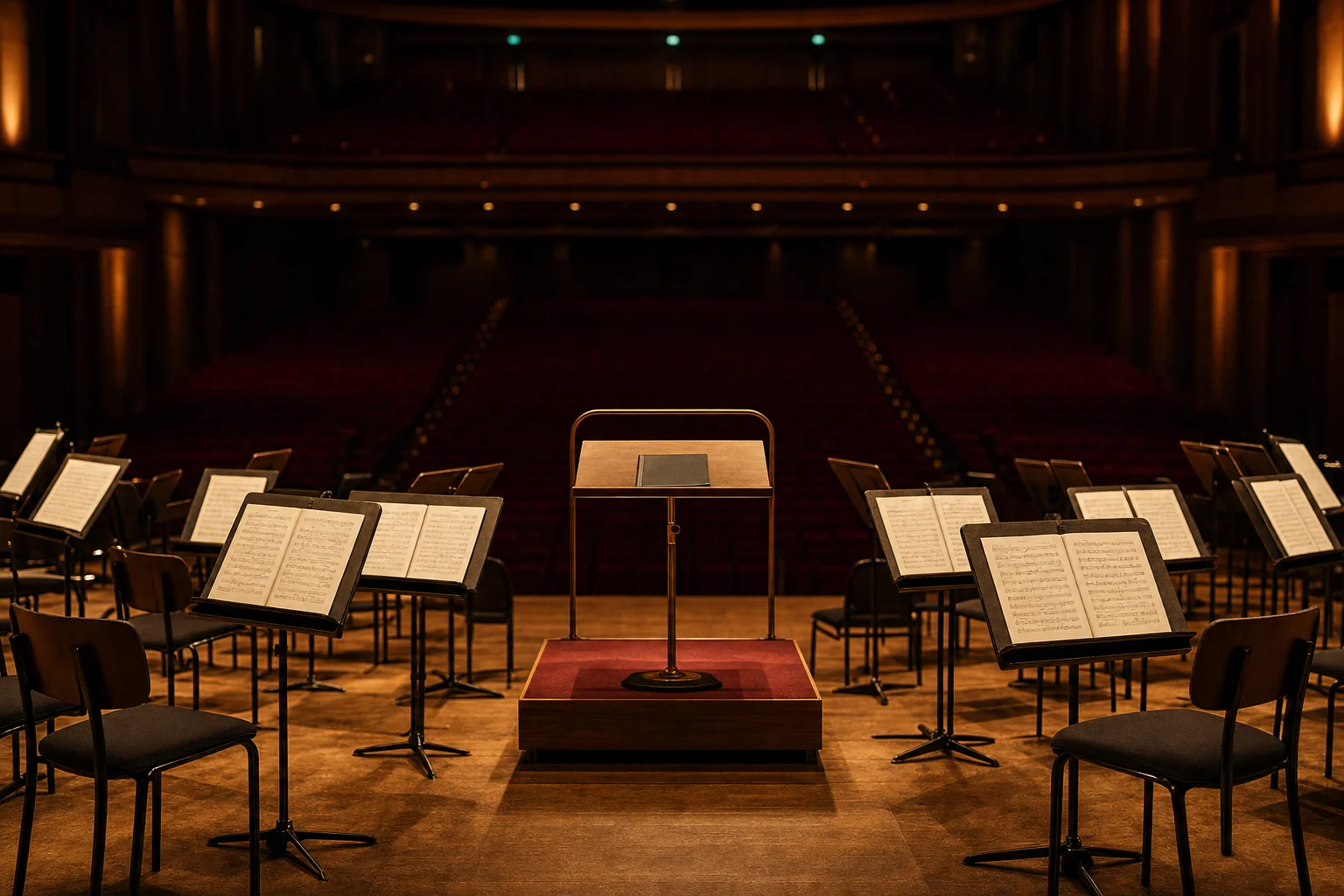
The six-week countdown
A professional season opener needs six weeks of preparation from the moment parts leave the library to the moment the concertmaster takes the A. Anything shorter is improvisation; anything longer loses tension.
The autumn concert cycle in Central Europe traditionally opens in mid-September. That gives most orchestras a return-from-summer window of roughly four working weeks plus a preparation phase during the last two summer weeks, when principals mark bowings and the librarian finalises parts. The season opener is the calling card of the entire year — the piece that reviewers will describe, that subscribers will remember, that sponsors will judge.
The framework below assumes a mixed programme: one substantial orchestral work, one concerto or vocal feature, and a crossover encore. It scales down for chamber orchestra and up for full symphonic forces.
Week minus six to minus five: library and score prep
Parts must leave the library no later than four weeks before the first tutti — six weeks for repertoire with unusual notation, extended techniques, or complex divisi.
The librarian's checklist at this stage is unglamorous but decisive: bowings entered by the concertmaster and section principals, page turns marked, cuts confirmed with the conductor in writing, transposition instruments cross-checked against the full score, and — for crossover repertoire — the arranger's clean master matched against the publisher's edition. A single wrong transposition in a horn part costs twenty minutes of tutti time.
The conductor, in parallel, marks the full score for structural landmarks: where the second subject enters, where the modulation lands, where the tempo relationship must be exact. This is the map that will govern every subsequent rehearsal decision.
The rehearsal architecture
A professional cycle uses four to six services distributed across two weeks; a semi-professional cycle stretches the same architecture across six to eight weeks of weekly evenings.
| Service | Focus | Duration | Timing |
|---|---|---|---|
| Sectional — strings | Bowings, unified articulation, divisi balance | 2 h | Week −4 |
| Sectional — winds & brass | Intonation, blend, solo passages | 2 h | Week −4 |
| First tutti | Architecture, tempi, structural read-through | 2.5 h | Week −3 |
| Second tutti | Detail work by movement, balance | 2.5 h | Week −2 |
| Piano probe with soloist | Concerto integration, ensemble | 2 h | Week −2 |
| General probe | Full run with soloists, minimal stops | 3 h | Week −1 |
| Dress rehearsal | Hall acoustic, lighting, concert order | 2.5 h | Day −1 |
The temptation is always to add a service. Resist it. Orchestras peak, then plateau, then decline. Six services is the professional sweet spot; a seventh usually costs energy that the concert needs.
Time budget by programme block
The rehearsal budget should reflect where the risk lives — not where the conductor's affection lies.
The crossover encore deserves comment. Ninety minutes seems generous until the arrangement arrives and the strings discover that the second violin part sits stubbornly in an awkward tessitura. Well-crafted arrangements — the kind that read cleanly at sight — save entire rehearsals. A published orchestral arrangement of A Million Dreams or Offenbach's Barcarolle should require balance work, not note-hunting.
Sectional discipline
Sectionals fail when they become mini-tuttis. Their job is unified bowing, articulation, and intonation — nothing else.
String sectionals are led by the concertmaster; wind and brass sectionals by the principal oboe or principal trumpet respectively. The conductor may attend but should not lead. The purpose of the sectional is to arrive at the first tutti with every desk playing the same articulation, the same bow distribution, the same colour on the same note. When that groundwork is done, the tutti is about music. When it is not, the tutti becomes a bowing meeting and the concert loses a rehearsal.
For choral collaborations — a Barber setting or a large-scale crossover with SATB forces — the choir must be prepared to a comparable standard before the first joint service. A prepared choir with clean diction and secure intonation makes the Agnus Dei or an SATB setting of Amazing Grace a matter of blend rather than survival.
The general probe and dress
The general probe answers one question: can we get through it? The dress answers a different one: does it sound like the concert?
The general probe should be run with soloists, minimal interruption, and a single objective — continuity. Stops are for genuine catastrophes, not preference. Notes taken during the run are addressed in the last thirty minutes.
The dress rehearsal moves to the concert hall. The acoustic is different, the light is different, the platform layout is different, the players are wearing concert dress and have eaten dinner. The dress is about calibrating to those variables. A conductor who tries to teach new interpretation at the dress will conduct a first concert full of hesitation.
Frequently asked questions
How many rehearsals does a professional orchestra need for a season opener?
A typical professional programme requires four to six services — two sectionals, two tutti rehearsals, a general probe, and the dress. Semi-professional ensembles should plan six to eight weeks with weekly tutti.
When should scores be distributed before the first rehearsal?
Parts should reach players no later than four weeks before the first tutti. For demanding repertoire — Strauss, Mahler, contemporary crossover — six weeks is the professional standard.
What is the ideal order for a season-opener rehearsal schedule?
Begin with string and wind sectionals, then combine for tutti runs focused on architecture, then detail work by movement, then a general probe with soloists, finally the dress in concert dress and hall acoustic.
How do I balance a crossover encore with the main programme rehearsal time?
Allocate one dedicated tutti to the crossover piece early in the cycle. Well-arranged crossover repertoire reads at sight for a professional orchestra, but balance and phrasing still need one focused rehearsal.