How a Professional Orchestral Arrangement Is Made
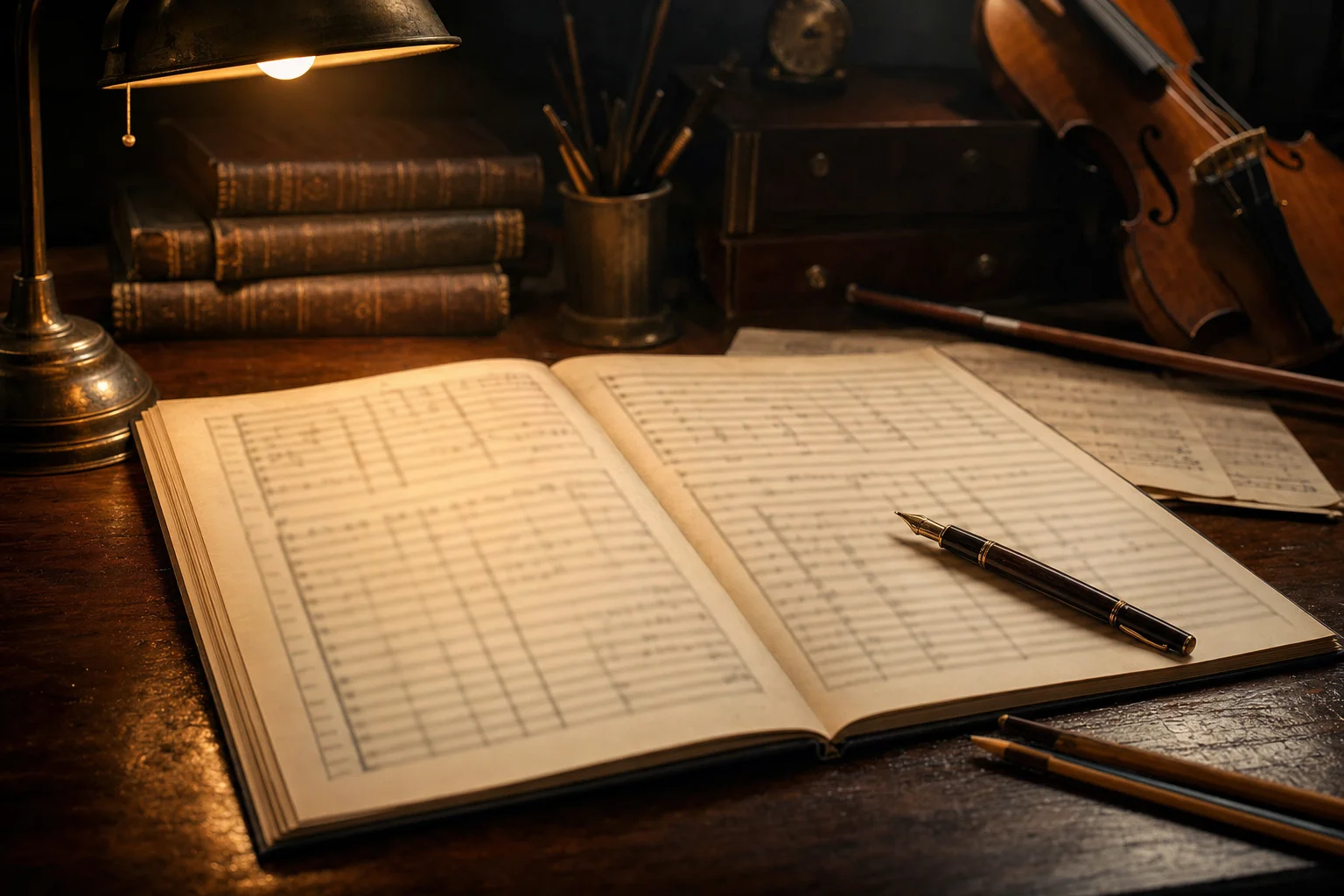
A professional arrangement is not a transcription, and it is certainly not a notation-software mock-up. It is a sequence of craft decisions — about structure, orchestration, voice leading and engraving — that make a score come alive in the hands of real players. After thirty years of arranging for professional ensembles, here is how one is actually made, and why every one of those decisions ends up in the music you buy.
The short version
- It begins with listening and analysis, not writing — understanding what makes the original work
- Then a structural sketch: key, form, and the dramatic arc for the ensemble
- Orchestration — writing idiomatically so each part is both playable and rewarding
- Engraving to MOLA standard — clean notation, sensible page turns, rehearsal marks
- Then part extraction, proofing, and the final test: real players at Abbey Road
1. It starts with listening, not writing
Before a single note is written, the work is to understand the piece — not just its melody and chords, but why it moves people. Where is the emotional centre? Which line is the protagonist? What is the harmonic engine underneath? A good arrangement begins as an act of analysis: taking apart what already works so that nothing essential is lost, and deciding what a new ensemble can add that the original never had.
2. The structural sketch
Next comes the architecture: the key (chosen for the voices and instruments that will actually perform it), the form, and the dramatic arc across the whole piece. This is where the most consequential decisions are made — what to keep, what to let breathe, and how to build from an intimate opening to a climax that lands. A three-minute song and a concert arrangement of that song are different animals; the sketch is where one becomes the other.
3. Orchestration — writing for real players
Orchestration is where craft becomes audible. Every part has to sit in a comfortable range, allow the player to breathe, and — crucially — be worth playing. The difference between an arrangement that is merely playable and one that is rewarding to play is the difference between a rehearsal the players endure and one they enjoy. Doublings are chosen so the texture blooms rather than muddies; inner voices get real lines instead of held pedal tones; and the whole is balanced so the melody always carries. This is the knowledge that a notation program cannot supply.
4. Voice leading and balance
In choral and orchestral writing alike, the test is whether every section has something genuinely musical to do. A choir that only sings block chords under the tune will disengage; a viola part that never leaves the harmony will too. Careful voice leading — independent, singable lines with their own shape — is what makes an ensemble sound committed. It is also what makes an audience feel the difference, even when they cannot name it.
5. Engraving to MOLA standard
How a score looks on the stand is not cosmetic — it is performance-critical. Professional engraving means the right staff size for legibility under stage lights, page turns placed at rests rather than mid-phrase, rehearsal marks and bar numbers where a conductor needs them, and spacing clean enough to sight-read. Every one of those details removes friction from the rehearsal room. A cramped, error-strewn free edition costs a conductor hours; a clean one gives that time back to the music.
6. Parts, proofing — and the test of real players
Only then are the individual parts extracted and checked, one by one, so that no player opens a folder to a missing Oboe 2 at the first rehearsal. And the final, honest test is the one no software can fake: putting the score in front of great musicians. Works published under this name are recorded with the London Symphony Orchestra at Abbey Road Studios, where an acoustic that reveals everything is the most exacting proofreader an arrangement can have. What survives that room is what you download.
Why this matters for the music you buy
All of this is the reason a professional edition and a free transcription are not the same product. When you buy one of these scores — whether a full-orchestra edition, a choir arrangement, or a crossover piece — you are buying music that has been designed for real players, engraved for real rehearsals, and tested by real orchestras. If you need something the catalogue does not yet hold, a bespoke arrangement follows exactly the same process, built for your ensemble.
Frequently asked questions
What makes a professional arrangement different from a free download?
A free download is usually a raw transcription or a notation-software export — the notes are there, but the craft is not. A professional arrangement makes hundreds of decisions a transcription cannot — idiomatic writing for each instrument, independent voice leading, breathing and page turns for real players, dynamics calibrated for balance, and clean engraving to MOLA standard. The difference is audible in the first rehearsal.
How long does a custom arrangement take?
It depends on the scale. A short transcription can take a few days; a full orchestral arrangement of a pop song may take a few weeks. Paul Lorenz sets a clear timeline before any work begins and can often accommodate urgent deadlines.
Can you arrange any song?
Almost. Public-domain works can be arranged freely; for a copyrighted song a licence may be required, and Paul Lorenz will guide you through it. Crossover arrangements of contemporary pop for orchestra, choir and ensemble are a particular specialty.
Do you offer custom arrangements for a specific ensemble?
Yes. Alongside the published catalogue, Paul Lorenz Music creates bespoke arrangements for a specific ensemble, key or occasion — from a reduced chamber version to an added choir. Contact us before you buy to discuss what you need.