Performing the European Anthem: what choirs and orchestras need to know
It officially has no words, Beethoven is free but the official version is not — and Europe's most familiar melody sits in a key that suits almost no amateur choir. A practical guide for anyone whose Europe Day deserves more than a recording played over the PA.
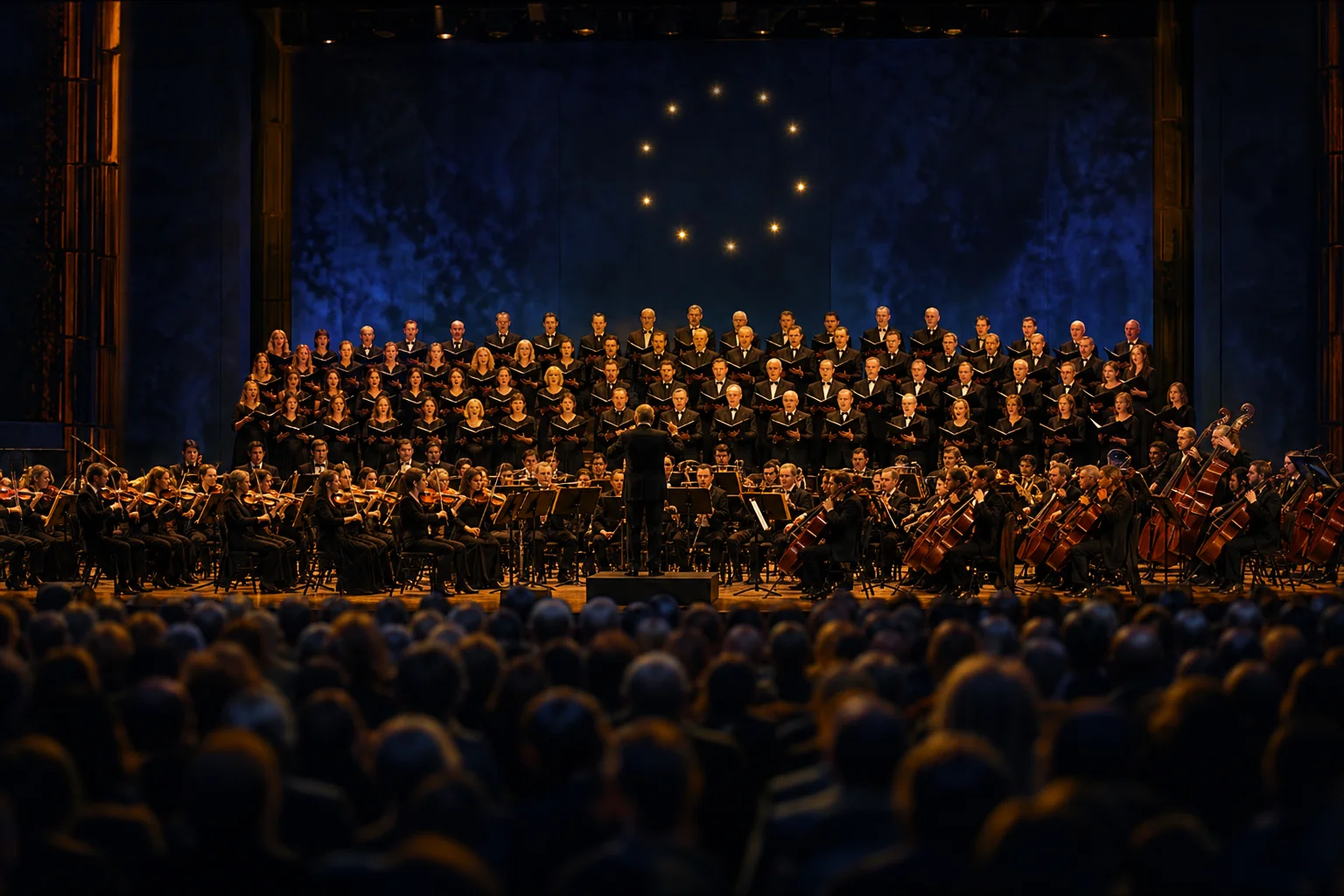
the Ode to Joy
Karajan writes the arrangement
the European anthem
The 1986 lyrics plan failed
5 May and 9 May
Council of Europe and European Union
Sooner or later the request arrives. A twin-town anniversary, a civic reception, a graduation, a Europe Day concert — and one line in the draft programme reads simply: "European anthem". For a conductor or choir director that line opens a series of questions to which the internet offers remarkably few useful answers. Which version is the official one? Are there words? May we sing them? And why is the recording the organiser sent so much slower than Beethoven?
I have conducted and arranged this piece in several settings, and the three things that always cost the most time are the same ones: the rights question, the key, and the length. What follows is what I would like to have known before the first programme meeting — with the sources behind it.
The European anthem is Beethoven's Ode to Joy theme, adopted by the Council of Europe in 1972; the European Union formally introduced the flag and anthem in Brussels on 29 May 1986. It is deliberately wordless — a lyrics competition collapsed in 1986 over Europe's many languages. Beethoven is in the public domain, but Karajan's official arrangement is not: it is published by Schott and Karajan retained the rights. To perform it you need either Karajan's material or another lawfully published arrangement of the free original. Two practical decisions then matter most: a key in which your sopranos are not defeated by the high A, and a length that fits the occasion — two minutes for a ceremony, three to seven for a concert.
What the European anthem actually is
The European anthem is the music of the Ode to Joy from the fourth movement of Beethoven's Ninth Symphony — without Schiller's text, in a purpose-made arrangement, and at a markedly slower tempo than the original.
The idea is older than the institutions. Proposals for a European anthem circulated between the wars, and after 1949 the newly founded Council of Europe became the destination for dozens of submissions — Chant de la paix, Hymnus europeus, Europa vacata, Paneuropa. In the end no new composition prevailed. What prevailed was the one melody everybody in Europe already knew.
In 1972 the Council of Europe formally adopted the Ode to Joy as the European anthem. Its Secretary General, Lujo Tončić-Sorinj, asked his fellow Austrian Herbert von Karajan for an arrangement that would lend itself to different forces. The Berlin Philharmonic set Schiller's verses aside and recorded the instrumental arrangement in D at a slower tempo, Karajan conducting; the recording was released by Deutsche Grammophon. It was finished just in time to be played in public at the Europe Day events in Strasbourg on 5 May 1972.
The European Communities followed a decade later. After the 1984 Fontainebleau European Council and the Adonnino committee's recommendations on a "Citizens' Europe", the flag and the anthem were officially introduced at a ceremony in Brussels on 29 May 1986. At the flag-raising, the Choir of the European Communities sang the ode — in its original German, with words. The anthem itself nevertheless remained wordless.
The anthem has no words, and that is deliberate
There are no official words to the European anthem. It is treated as purely instrumental music, because in a community with two dozen official languages no single language could be placed above the others.
This was not an oversight but a question left open on purpose — and a serious attempt was made to close it. In October 1986 the European Parliament's President's office examined a competition across what were then twelve member states to produce a text for the anthem. The brief was remarkably specific: the very first verse was to extol "the crucial theme of the union of the peoples of Europe", and it had to include the line all men shall be brothers from Schiller's ode. A panel of literary critics and members covering every official language was to be assembled.
The plan failed. Suggestions arrived in quantity, but neither the linguistic nor the literary problem could be solved, and the idea of using the German version alone met resistance. To this day the anthem remains what it became in 1972: music without words.
Beethoven is free — the official version is not
Beethoven's music and Schiller's text are in the public domain. Karajan's arrangement of the European anthem is not: it is published by Schott Music in Mainz, and Karajan retained the rights to its recording and distribution — much to the Council of Europe's frustration.
This is where most plans stumble, because it is so counter-intuitive. "But Beethoven is public domain" is true — and it does not answer the question. What is in the public domain is the work. A particular arrangement of that work is a separate creative act with its own protection, and the official anthem version is exactly that.
In practice you have three clean routes. First, obtain Karajan's Schott-published material through normal channels, in one of its three versions for symphony orchestra, wind instruments or solo piano. Second, use another lawfully published arrangement of the free original — several publishers offer one. Third, have the piece set for your own forces, which is equally legitimate because the original is free.
What does not work is the fourth route, the one you see most often in practice: printing a PDF of unknown origin forty times for the choir. Quite apart from the rights question, that almost always gets you badly engraved parts with no page turns — and you find out at the dress rehearsal.
Separate from the arrangement question is reporting the public performance to a performing-rights society. For a public-domain work in a public-domain arrangement, no royalties are due for the music; the moment a protected arrangement is performed, it becomes reportable. As always the organiser makes that report — ASCAP, BMI or PRS in the English-speaking world, GEMA, AKM or SUISA in German-speaking countries.
Two Europe Days — and you need the right one
The Council of Europe marks 5 May, the European Union marks 9 May. Both are "Europe Day", and confusing them puts your concert four days beside the occasion.
| Date | Whose day | What it marks |
|---|---|---|
| 5 May | Council of Europe | The signing of the Statute of the Council of Europe in London in 1949 — designated Europe Day in 1964. It was on this day in 1972 that Karajan's arrangement was first played in Strasbourg. |
| 9 May | European Union | The anniversary of the 1950 Schuman Declaration. This is the day most towns, schools and societies mean today when they say "Europe Day". |
For programming this means one thing: ask the organiser. If the invitation comes from a municipality, a Europe Direct centre, a school or a twinning committee, it is almost always 9 May. If it comes from the orbit of the Council of Europe, it is 5 May.
The problem that catches every choir: the high A
Beethoven sets the finale in D major and asks the sopranos for a long sustained high A in the tutti. Karajan's anthem arrangement is also in D. For amateur and church choirs a lower key is therefore not a convenience but the precondition for the writing to work at all.
The passage is notorious. Beethoven wrote his choral finale with a disregard for singers' throats that even professional choirs respect; the sopranos sit at the top of their range for long stretches and have to articulate text while they are up there. In a professional chorus that is a task. In a volunteer choir rehearsing two hours on a Tuesday it is an imposition — and you hear it immediately: the intonation sags, the tone constricts, and the melody everyone is supposed to be able to join in with becomes an act of strength.
The remedy is unglamorous and works at once: an arrangement in a lower key. A fourth down, in G major, keeps the melody inside the staff in all four voices. The character changes less than you fear — if anything the anthem sounds warmer — and you gain exactly the security an audience needs if it is meant to sing along at the end.
Which forces? Four routes that actually work
None are prescribed. Karajan deliberately supplied three versions in 1972 — symphony orchestra, wind band, solo piano — because the Council of Europe wanted the full range of European occasions covered. In practice four routes have proved themselves.
| Forces | Suits | What matters |
|---|---|---|
| Wind band | Outdoor ceremonies, flag-raisings, town festivals, processions | Carries without amplification and without a hall rehearsal. Needs an arrangement with a clear melodic register, or the theme disappears into the texture. |
| Organ | Churches, ecumenical services, small occasions, short-notice requests | The fastest solution there is: one player, no rehearsal call. Keep the registration bright and lean, or the anthem turns heavy. |
| Choir & piano | Rehearsal, school ceremonies, receptions, civic halls | The normal case, and the version you will rehearse from anyway. Make sure the choral score puts all four voices on one page. |
| Choir & orchestra | Concerts, anniversaries, season finales, twin-town concerts | The version people remember the piece by. What decides it is whether every part is individually written out — otherwise the material costs you more evenings than the rehearsals. |
One note on running order that will save you trouble: the European symbols were never intended to replace national ones, only to set shared values alongside them. If both are heard at your event, the European anthem is not competing with the national anthem — but agree the sequence with the organiser's protocol office in advance, because no binding rule exists.
Two minutes or six? The real programming decision
The ceremonial anthem is short: the theme only, about two minutes, made for the moment of a flag-raising or the opening of a formal event. That is not a concert piece — a concert needs a written-out version with an introduction, a build and an ending.
This distinction shapes the evening more than any other. Put the ceremonial version in a concert and after two minutes you have played something that sounds like an announcement and ends like one: the audience does not know whether to applaud. Conversely, a seven-minute concert version at a flag-raising sounds as though somebody misread the running order.
For a concert the useful range is three to seven minutes. Long enough for the melody to travel — a quiet introduction, a restrained first statement, then the full texture — and short enough that you can prepare it alongside the main programme. And there is one more argument for staying in that range: an ending that fades rather than stops on the final bar gives the hall the moment an evening like this needs.
Beethoven's complete finale is by comparison a different undertaking altogether — some twenty-five minutes, four vocal soloists, piccolo and contrabassoon, four horns, three trombones, percussion and a symphony-sized choir. It is magnificent, and it is simply not available to 99 per cent of the ensembles who get asked to play on Europe Day.
How to recognise usable material
You recognise a good edition not by its score but by its parts: individually extracted, proofread, with sensible page turns — and by a choral score you are allowed to print for every seat in the choir.
The expensive item in choral material is not the music but the copies. Many publishers sell the choral score per copy; with forty singers that quickly exceeds the cost of the entire orchestral set. So check two things before buying: is a choral score included at all — and may you print it for your ensemble?
Our own edition of the Ode to Joy for orchestra and SATB choir is built around exactly these points: G major instead of D major, so no voice climbs above the staff; the solo stanzas taken from within your own choir rather than by guest soloists; single woodwinds, one horn, one trumpet, two trombones, timpani, snare drum and strings — forces a community orchestra with a church choir can genuinely field; and a seven-page choral score you may print without limit. The complete recording is on the product page to listen to.
Frequently asked questions
Does the European anthem have official lyrics?
No. The European anthem is officially a purely instrumental piece with no words. In 1972 the Council of Europe deliberately adopted the music of the Ode to Joy, not Schiller's text. In 1986 the European Parliament seriously explored a competition for anthem lyrics in every official language — the brief even specified that the line "all men shall be brothers" from Schiller's ode had to appear. No solution to the linguistic problem was ever found, and the anthem stayed wordless. A choir may of course sing Schiller's original text; it is then performing Beethoven's ode, not the ceremonial anthem.
Is the European anthem in the public domain?
Beethoven's music and Schiller's text are in the public domain, so no royalties are due for the work itself. The official anthem arrangement is not: Herbert von Karajan wrote it in 1972 at the Council of Europe's request, it is published by Schott Music in Mainz, and Karajan retained the rights to the recording and distribution of his arrangement. To perform the European anthem you therefore need either Karajan's licensed material or another lawfully published arrangement of the free original.
When is Europe Day?
There are two. The Council of Europe marks 5 May — the day its Statute was signed in London in 1949; it was designated Europe Day in 1964. The European Union marks 9 May, the anniversary of the 1950 Schuman Declaration. Karajan's arrangement was first performed in public in Strasbourg on Europe Day, 5 May 1972. For programming, simply check which of the two dates your organiser means.
How long is the European anthem?
The ceremonial version is short — it covers the theme only, runs about two minutes, and is designed for a flag-raising or the opening of a formal event. That is not enough for a concert: a concert performance needs a written-out arrangement with an introduction, a build and an ending, typically three to seven minutes. Beethoven's complete finale of the Ninth, by contrast, runs some twenty-five minutes and is an entirely different undertaking.
Why is the Ode to Joy so hard for amateur choirs?
Because of the key. Beethoven sets the finale in D major and asks the sopranos for a long sustained high A in the choral tutti — one of the most notorious passages in the choral repertoire, written with no regard for singability. Karajan's anthem arrangement is also in D. For amateur and church choirs the practical answer is an arrangement in a lower key, such as G major, where the melody stays inside the staff.
What forces does the European anthem require?
None are prescribed. Karajan supplied three versions — for symphony orchestra, for wind instruments and for solo piano — precisely because the Council of Europe wanted that range covered. In practice four routes work: wind band for outdoor ceremonies, organ for churches and small occasions, choir with piano for rehearsal and civic celebrations, and choir with orchestra in concert. What matters is not the size but whether the material is genuinely written out for the forces you have.
Can a choir sing the European anthem?
Yes. The official anthem is wordless, but nothing stops an organiser from performing the Ode to Joy with Schiller's text — which is exactly what happened in Brussels on 29 May 1986, when the Choir of the European Communities sang the ode in its original German at the flag-raising ceremony. The only thing that matters is knowing the difference and not blurring it in the programme note.
What is the difference between the European anthem and Beethoven's Ninth?
The European anthem is the theme Beethoven introduces in the fourth movement of his Ninth Symphony — as an anthem it is wordless, in a purpose-made arrangement and at a markedly slower tempo than Beethoven's. Beethoven's finale is the whole movement: some twenty-five minutes, four vocal soloists, a large choir and an orchestra with piccolo, contrabassoon, four horns, three trombones and percussion. Almost nobody who puts "the European anthem" on a programme means the complete movement.