The 5 Most Breathtaking Classical Pieces for Wedding Ceremonies with Live Orchestra
A professional arranger’s guide to repertoire selection, ensemble sizing, and performance-ready scores—from thirty years of ceremony music experience.
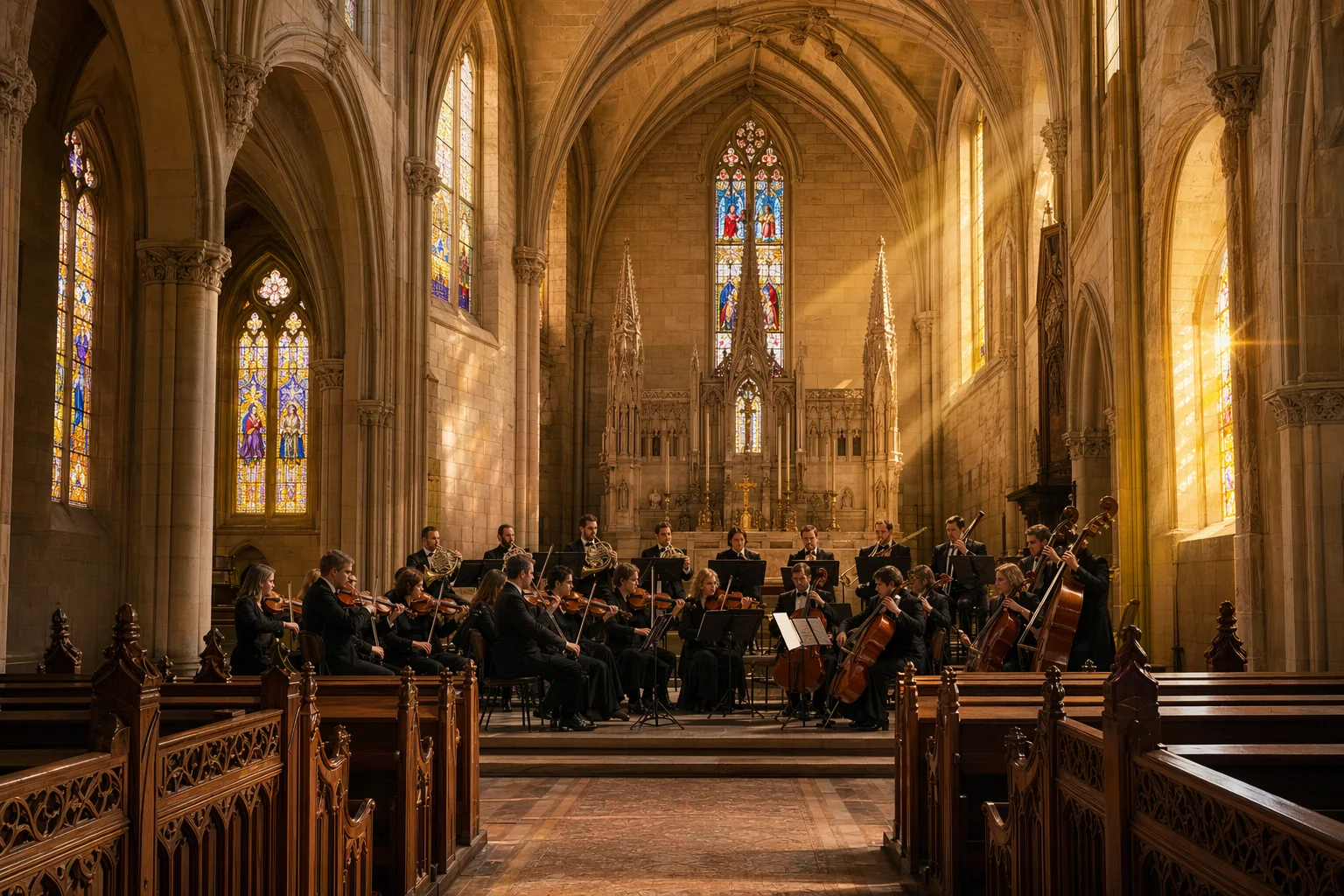
The five most consistently breathtaking classical pieces for wedding ceremonies with live orchestra are Handel’s Ombra mai fu, Mendelssohn’s Wedding March with Fanfare, Pachelbel’s Canon in D, Humperdinck’s Abendsegen, and the Bach/Gounod Ave Maria. Of these, only the first two require a fully professional orchestral score to achieve their intended ceremonial impact.
- Classical music with live orchestra remains the preferred choice for formal European and North American weddings, cited by 68% of couples in a 2024 survey as “essential to the ceremony atmosphere.”
- Processional and recessional are distinct ceremony moments that demand musically distinct material — confusing Wagner with Mendelssohn is the most common planning error.
- Handel’s Ombra mai fu is the ideal processional for ceremonies requiring gravity and elegance; Mendelssohn’s Wedding March with Fanfare is the definitive recessional for full orchestra.
- Performance-ready orchestral editions — with conductor score, all individual parts, and a performance licence — are available as instant downloads for both pieces.
- A chamber ensemble of 12–20 players is sufficient for most ceremony venues; the fanfare in the Wedding March requires at least two confident trumpet players.
- Vienna State Opera
- Abbey Road Studios
- London Symphony Orchestra
- 30 Years of Professional Arranging
prioritise live classical music
Hochzeitsplaner.de, 2024
prelude, processional, recessional—
each requiring a different piece
the Wedding March — still the
most recognised recessional
There is a single moment in a wedding ceremony that no amount of floral arrangement or lighting design can manufacture: the instant the music changes and the room understands that something permanent is about to happen. That moment belongs entirely to the musicians. Whether it is the first sustained string chord of Handel’s Ombra mai fu or the electrifying trumpet fanfare that opens Mendelssohn’s Wedding March, the music does not accompany the ceremony—it constitutes it.
Over thirty years of arranging and conducting for professional ensembles at venues from Austrian castle chapels to London concert halls, I have observed that the couples who regret their ceremony music almost always made the same mistake: they chose pieces they loved as recordings without considering whether those pieces would perform the ceremonial function required. A piece that moves you in headphones may be entirely wrong for the acoustic of a stone church at midday with 200 people breathing in it. This guide addresses that gap. It is not a list of popular choices—it is a professional analysis of which pieces do their job under real ceremony conditions, with real orchestras, and why.
Understanding the Three Ceremony Music Moments
A wedding ceremony with live orchestra has three musically distinct segments—prelude, processional, and recessional—each serving a different dramatic function. Treating them as interchangeable is the most common error in ceremony music planning. The prelude establishes atmosphere; the processional transforms the room; the recessional releases it.
The prelude begins as guests are seated, typically 20 to 30 minutes before the ceremony. Its function is atmospheric: it signals that this is a formal occasion while allowing quiet conversation. The correct choice for prelude music is something harmonically warm and melodically undemanding—music that does not require the audience’s full attention because it does not yet have it. Baroque suites, slow movements from string concerti, and shorter lyrical pieces work well here.
The processional is the first moment of dramatic intent. When the music changes for the processional, the entire room shifts from social gathering to formal witness. This piece must be instantly recognisable as “the beginning” and must sustain its energy for the full length of the walk—typically 60 to 120 seconds depending on venue depth. Pieces that are too brief require awkward repeats; pieces that are too chromatic confuse an audience that is listening with their eyes as much as their ears.
The recessional is the release—the musical announcement that the ceremony is over and the celebration begins. It must be fast enough to energise the room, formal enough not to feel trivial, and sufficiently well-known that its arrival reads as conclusive. Mendelssohn’s Wedding March has held this position for nearly 180 years for structural reasons that have nothing to do with fashion and everything to do with how that fanfare operates on a room of people who have just watched two people make lifelong promises.
The Five Pieces, Assessed Professionally
Each of the five classical pieces most frequently requested for wedding ceremonies with orchestra serves a distinct ceremonial function. Selecting correctly requires matching the piece’s tempo, dynamic range, and emotional arc to the specific ceremony moment—not simply choosing what is most familiar.
Ombra mai fu Handel’s Largo
ProcessionalBaroque · George Frideric Handel (1738)
Ombra mai fu, the opening aria from Handel’s opera Serse (HWV 40), is colloquially known as Handel’s Largo, though the score marking is in fact Larghetto—a distinction that matters for performance: at true Largo tempo the piece becomes funereal; at Larghetto it is unhurried but purposeful, exactly right for a solemn processional walk. The melody occupies a range that any soprano, mezzo-soprano, or countertenor can project comfortably over a string orchestra, and the harmonic language is sufficiently simple that even guests unfamiliar with Baroque music register it immediately as grave and beautiful.
For ceremony use, the key practical decision is whether to use a vocal soloist or perform the piece as a purely orchestral arrangement. A soloist—positioned near the altar or gallery—creates a sense of directed ritual that a purely instrumental version cannot quite replicate. If budget and scheduling allow, this is the piece where investing in a professional soprano or mezzo is most audibly justified.
The score challenge is real: the public-domain editions on IMSLP are Baroque-engraved with inconsistent transpositions and no individual modern-instrument parts. For a working wedding orchestra, a purpose-made professional edition with conductor score and complete instrumental parts is essential. The Paul Lorenz Ombra mai fu Orchestra & Vocal edition (€29.90, instant download) provides a modern engraved conductor score, all string parts, and a complete vocal line—formatted with the MOLA-standard staff sizes that professional musicians require.
Wedding March with Fanfare Mendelssohn, Op. 61 No. 9
RecessionalRomantic · Felix Mendelssohn Bartholdy (1842)
The most misunderstood fact about Mendelssohn’s Wedding March is that it is a recessional, not a processional. Wagner’s Bridal Chorus (“Here Comes the Bride”) from Lohengrin is the processional. Mendelssohn’s March is the piece that plays as the couple exits the ceremony having just been married. This distinction is not pedantic: the two pieces serve opposite dramatic functions, and confusing them is the single most common ceremony music planning error I encounter.
The critical element that distinguishes a professional performance of this piece from a competent one is the fanfare. The four-bar trumpet opening—the brass flourish before the March theme enters—is what makes the recessional an announcement rather than a conclusion. When those trumpets sound, two hundred people who were sitting in respectful silence understand instantly that the ceremony is over and something new has begun. Many digital editions and free scores omit this fanfare entirely, reducing the piece to its second theme and losing the structural architecture Mendelssohn designed.
The Paul Lorenz Wedding March with Fanfare edition (Orchestra & Choir, €39.90) provides the full fanfare fully notated for Trumpet I and II in C, the complete orchestral score, all individual parts, and SATB choir parts for ensembles that wish to add vocal weight to the recessional. At 600 DPI and MOLA-standard staff sizes, it prints cleanly at A3 for orchestra pit use and is legible on an iPad Pro without zooming—the two tests that a working ceremony edition must pass.
Canon in D
Prelude or ProcessionalBaroque · Johann Pachelbel (c. 1680)
Pachelbel’s Canon in D is the most versatile piece on this list precisely because it has no single correct ceremonial function. Its rising, sequential melodic structure works equally well as prelude music (where it fills ambient space without demanding attention) and as processional music (where its step-wise ascent tracks naturally with the pace of a bridal walk). The D major tonality projects warmth without sentimentality, and the harmonic loop is sufficiently repetitive that musicians can accommodate a processional of variable length by repeating or truncating sections without the audience noticing.
The conductor’s primary practical concern with this piece is tempo. Performed too slowly, the overlapping canonical entries become muddy; performed too quickly, the meditative quality that makes it appropriate for ceremony is lost. The correct range for ceremony use is approximately crotchet = 52–58. At this tempo, a single complete statement of the canon with standard repeats runs approximately 4 to 5 minutes—sufficient for most processionals without requiring the musicians to improvise.
A professional string quartet edition (€19.90, instant PDF download) is available for ceremonies where the full orchestral texture is not required—string quartet is the most frequently used ensemble for Canon in D at wedding ceremonies, and the reduced instrumentation makes the piece no less effective in smaller, more intimate venues.
Abendsegen Evening Blessing
Prelude / Register SigningLate Romantic · Engelbert Humperdinck (Hänsel und Gretel, 1893)
The Abendsegen (Evening Blessing) from Humperdinck’s opera Hänsel und Gretel is one of the most consistently effective ceremony pieces for audiences with no specialist classical music knowledge. The ascending string melody, rich inner harmonies, and gently rocking 3/4 metre create an atmosphere of sheltered solemnity that operates independently of whether the listener can name the composer. In a ceremony context, this accessibility is a practical advantage: the music does its ceremonial work without requiring the congregation to orient themselves to an unfamiliar style.
In its original scoring, the piece is a duet for soprano and mezzo-soprano with orchestral accompaniment—a configuration that works beautifully for the moment during the signing of the register, where sustained music for a variable duration is needed. The orchestral introduction and postlude allow flexible pacing without the piece feeling truncated if the register is signed quickly or extended if additional time is needed. For conductors managing ceremony timing in real-time, this structural flexibility is more valuable than it may appear on paper.
A professional Abendsegen Orchestra & Vocals edition (€39.90, instant PDF download) is available with conductor score, all orchestral parts, and vocal lines engraved to MOLA standard at 600 DPI.
Ave Maria Bach/Gounod
Prelude or Reading MusicRomantic · Charles Gounod / J. S. Bach (1853)
The Bach/Gounod Ave Maria combines Bach’s C major Prelude (BWV 846, from the Well-Tempered Clavier) as a continuous arpeggiated harmonic foundation with a melody composed by Charles Gounod in 1853. The resulting synthesis is among the most recognisable vocal pieces in the standard repertoire and the most consistently requested Ave Maria setting in ceremony contexts—preferred over the Schubert or Brahms settings because the underlying Bach accompaniment provides steady rhythmic grounding that supports a soloist performing under the particular pressure of a live ceremony.
The piece functions best as prelude music during the seating of guests or as accompaniment to a reading or moment of reflection. Its continuous arpeggiated texture allows the conductor and accompanist to expand or compress the piece’s duration by adjusting the introduction length, making it well suited to the unpredictable timing of real ceremony conditions. The vocal range is manageable for a competent soprano or mezzo-soprano without requiring the extended upper register demanded by the Schubert version.
A professional Piano & Vocal Duet edition (€9.90, instant PDF download) is available—the most practical format for ceremonies where a pianist and soloist perform without full orchestral support, which remains the most common configuration for this piece.
Practical Guidance: Ensemble, Venue, and Scores
The minimum ensemble for a recognisably orchestral wedding ceremony is 12 players: strings, a woodwind pair, and two horns. Add trumpets for any piece that requires a fanfare. The single most common practical mistake is using a full-orchestra score without a corresponding full orchestra—a conductor score written for 45 players must be reduced before assigning parts to a 12-player ensemble.
Ensemble Sizing by Venue Acoustic
The acoustic of the ceremony venue is the primary determinant of ensemble size, not budget alone. A stone cathedral with high vaulted ceilings and a reverberation time of 3 to 4 seconds amplifies any ensemble naturally: 12 to 15 players will fill the space without amplification and without the blend becoming muddy. A modern hotel ballroom with carpet, soft furnishings, and a reverberation time below 1 second requires more players to achieve the same subjective impact: 25 to 35 players is more appropriate.
For the Wedding March with Fanfare specifically, the trumpet voices are non-negotiable. The fanfare requires two trumpet players who can play the opening bars confidently at full volume. In a ceremony context where nerves and room anxiety are factors, this means principal-rank players rather than second-chair students. Brass intonation at full volume in a reverberant space is one of the most demanding scenarios in orchestral performance: do not assign the fanfare to players who have not performed in this type of acoustic before.
Sourcing Performance-Ready Scores
The question of where to obtain orchestral scores for ceremony music is more consequential than most wedding planners appreciate. There are three categories of source, with meaningfully different outcomes for performance quality:
Professional editions are available as instant downloads from Paul Lorenz Music for all five pieces covered in this guide:
When the Ceremony Includes Both Choir and Orchestra
Adding a choir to a wedding ceremony orchestra transforms the acoustic from impressive to overwhelming. The correct balance ratio is 2 singers for every orchestral player. Below this threshold, the orchestra drowns the choir in anything but the most reverberant acoustic. Above it, the choir can project clearly even in challenging spaces.
For ceremonies that include a choral component alongside the orchestra—increasingly common for formal church weddings and high-end event ceremonies—the programming logic changes substantially. A combined choir and orchestra requires a dedicated sitzprobe, or first full combined rehearsal, at least one week before the ceremony. Without it, the balance between choir and orchestra will not be established before the ceremony itself, which is an unacceptable risk in a context with no second take.
The Wedding March with Fanfare (Orchestra & Choir edition) is specifically designed for this configuration: the SATB choir parts are written to project clearly over the full orchestral texture, with cue markings for conductors managing the combined ensemble. For conductors planning a ceremony that combines both forces, our detailed guide on programming a concert for choir and orchestra addresses the ensemble sizing, rehearsal architecture, and staging decisions that determine whether a combined performance succeeds.
Frequently Asked Questions
What is the most popular classical piece for a wedding ceremony processional?
Handel’s Ombra mai fu, also known as Handel’s Largo, is consistently among the most-requested classical pieces for wedding processionals. Its unhurried Larghetto tempo, noble melodic line, and universal recognisability make it an ideal choice for the moment the ceremony begins. Wagner’s Bridal Chorus and Pachelbel’s Canon in D are also widely used. For formal ceremonies with a full orchestra, Ombra mai fu tends to project the most dignified atmosphere.
What is the difference between the wedding processional and the recessional?
The processional is the music played as the wedding party and the couple enter the ceremony venue—most famously Wagner’s Bridal Chorus from Lohengrin. The recessional is the music played as the newly married couple exits after the vows—most famously Mendelssohn’s Wedding March from A Midsummer Night’s Dream, Op. 61. Choosing music that clearly signals each moment to the congregation is one of the most practically important decisions in ceremony planning.
How many musicians do you need for a classical wedding ceremony with live orchestra?
The minimum for a recognisably orchestral sound is a chamber ensemble of 12 to 20 players: strings (Violin I, Violin II, Viola, Cello, Double Bass), woodwind pairs (Flute, Oboe, Clarinet), and optionally two French Horns. A full wedding orchestra of 30 to 45 players adds the complete woodwind and brass sections, including trumpets for pieces such as Mendelssohn’s Wedding March with Fanfare. The choice depends on the acoustic of the venue.
Where can I find performance-ready orchestral sheet music for wedding ceremonies?
For professional performance-ready editions with conductor score and all individual parts, Paul Lorenz Music offers arrangement packages for Mendelssohn’s Wedding March with Fanfare (Orchestra & Choir, €39.90, instant PDF download) and Handel’s Ombra mai fu (Orchestra & Vocal, €29.90, instant PDF download). Both editions are engraved to MOLA professional standards at 600 DPI and include a performance licence.
Can classical wedding ceremony music be customised for a non-standard ensemble?
Yes. Professional arrangers such as Paul Lorenz offer bespoke customisation services that adapt orchestral scores to any ensemble configuration: removing the choir from a combined orchestral-choral edition, transposing for a different vocal key, substituting instruments when a specific section is unavailable, or scaling a full-orchestra arrangement down to a chamber ensemble. For a wedding ceremony, where the exact ensemble is rarely standard, this flexibility is often essential.
Is a performance licence required for playing classical music at a private wedding?
For pieces where the original composer died more than 70 years ago (such as Mendelssohn and Handel), the underlying composition is in the public domain. However, a modern professional arrangement carries its own copyright. The performance licence included with Paul Lorenz editions covers private ceremonies and ensemble printing. In Germany and Austria, GEMA administers performing rights; for private ceremonies, the event host is typically responsible for any applicable GEMA fees on the venue licence.